The Look of Sinners
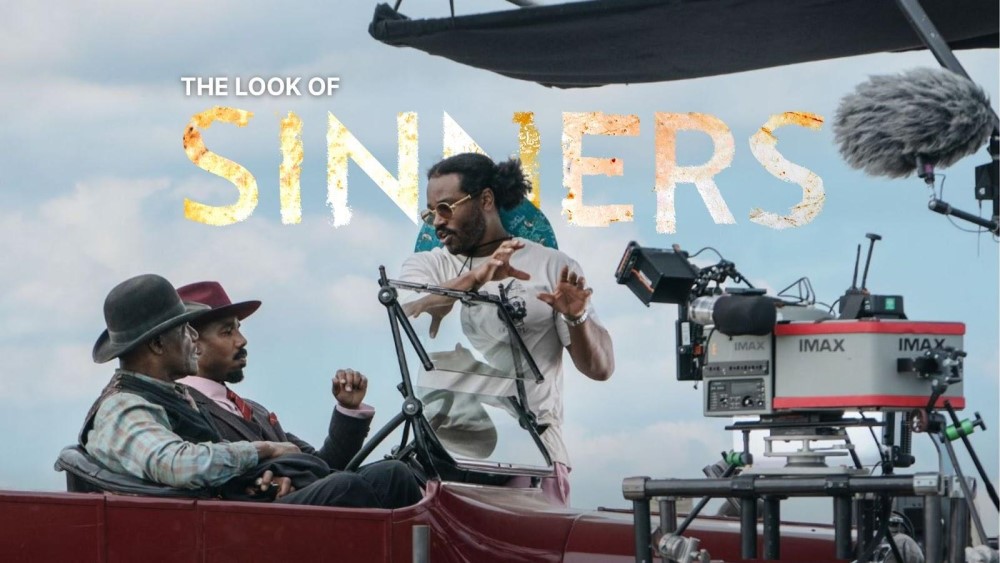
“You keep dancing with the devil… one day he’s gonna follow you home.”
—Jedidiah
In the world of contemporary cinema, there is a certain gravitational pull toward Ryan Coogler. He is a director who has masterfully navigated the line between massive blockbuster spectacle and intimate, culturally urgent storytelling. With his 2025 release, Sinners, Coogler reunites with longtime collaborator Michael B. Jordan to deliver what is arguably his most layered work to date. It’s a supernatural period piece while operating as a sharp interrogation of the American Jim Crow era.
(SPOILERS AHEAD!)
Set in 1931 Mississippi, Sinners follows twin brothers Smoke and Stack (both played by Jordan) as they return to their hometown after years away to open a juke joint. But underneath the social commentary masked as a vampire movie akin to From Dusk Till Dawn, Coogler builds a world where the monsters are not just creatures of the night, but the systemic horrors of colonization and cultural erasure. The film uses the vampire mythos to explore the lived realities of Black Americans, weaving a dense symbolic architecture through religion, hoodoo, and the raw, ancestral power of the Blues.
| PRO TIP: Bookmark this page so you can easily refer back to it later. |
The visual language of Sinners is one of moral dichotomies, capturing the sacred versus the profane. It is a film where a single guitar can pierce the veil between life and death and where a blood-red dress on a grieving mother establishes a theatrical, operatic tone that haunts every frame. From the haunted juke joints to the blood-stained floors of small southern churches, Coogler captures a vision of the South that is as theatrical as it is emotionally devastating.
This is the aesthetic of survival and cultural resilience. It’s the visual language of a community refusing to let its ever-changing history be staked.
This is The Look of Sinners.

CONTENTS:
|

♩ SINNERS TECH SPECS ♭
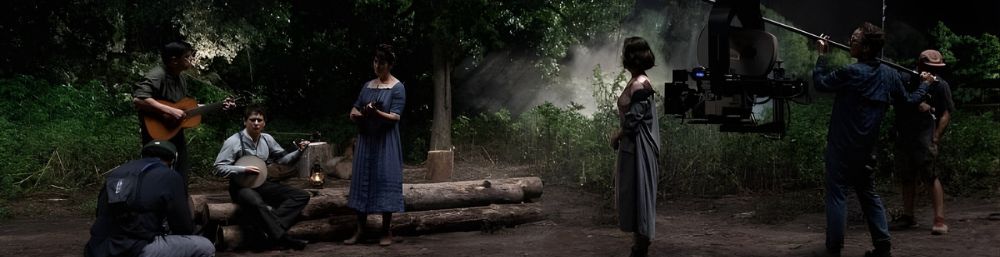
- Runtime: 2 hours 17 minutes (137 minutes)
- Color:
- Color
- Aspect Ratio:
- 1.43 : 1 (IMAX 70mm & Dual Laser, some scenes)
- 1.78 : 1 (IMAX Blu-ray, 4K UHD, DVD, and Digital, some scenes)
- 1.90 : 1 (IMAX Xenon & Single Laser, some scenes)
- 2.76 : 1
- Camera:
- IMAX MKIV, Panavision IMAX Lenses, Petzval, and Canon EF Lenses (for capturing the Moon)
- IMAX MSM 9802, Panavision IMAX Lenses, Petzval, and Canon EF Lenses (for capturing the Moon)
- Panavision 65 HR Camera, Panavision Ultra Panatar Lenses
- Panavision System 65 Studio, Panavision Ultra Panatar Lenses
- Negative Format:
- 65mm (also horizontal, Kodak Vision3 500T 5219, Ektachrome 100D 5294)
- Cinematographic Process:
- Digital Intermediate (4K, master format)
- IMAX (source format)
- Ultra Panavision 70 (anamorphic, source format)
- Printed Film Format:
- 70 mm(also horizontal, also IMAX DMR blow-up, Kodak Vision 2383)
- D-Cinema
- DCP Digital Cinema Package
A RECORD-BREAKING RECEPTION: 16 OSCAR NOMINATIONS
The artistic mastery displayed in Sinners has not only captivated audiences but has also rewritten Hollywood history. In January 2026, the film shattered Academy Award records by securing 16 Oscar nominations. This is the most for any single film in history (surpassing the previous record of 14). This achievement underscores the film’s dominance across all craft and performance categories, including Best Picture, Best Director for Ryan Coogler, and Best Actor for Michael B. Jordan’s dual performance.
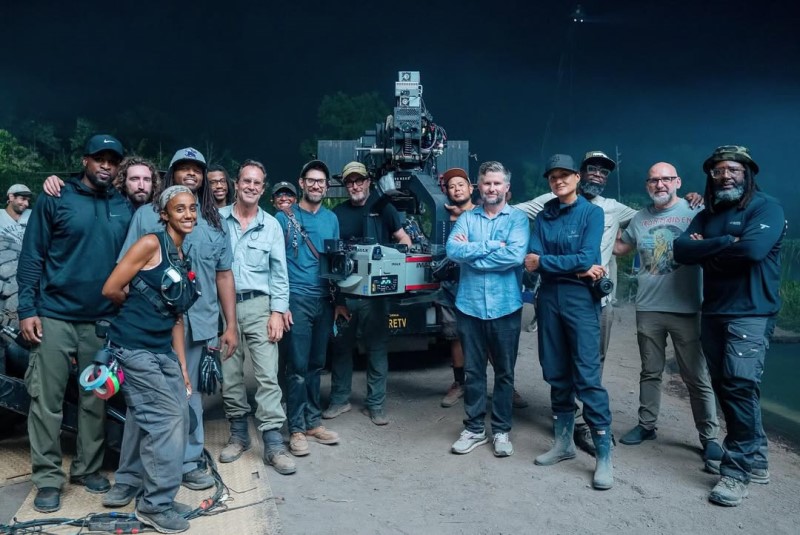
Courtesy of Eli Joshua @eli_joshua
The nominations celebrate the very “handmade” aesthetic explored in this article, with nods for Best Cinematography (Autumn Durald Arkapaw), Best Production Design (Hannah Beachler), and Best Costume Design (Ruth E. Carter).
The New York Times noted that the film’s success — alongside a $368 million box office run — sends a “clear political message” from the film establishment, rallying around a “horror fantasia” that serves as a potent allegory for racism and cultural appropriation.
♩ THE WORLD OF SINNERS ♭
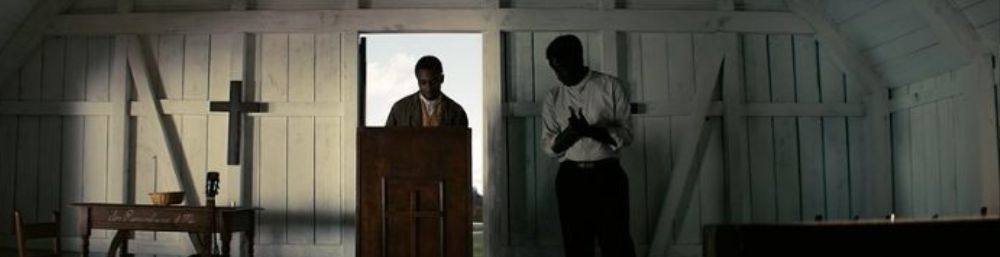
Ryan Coogler’s Sinners is set against the atmospheric and oppressive backdrop of 1931 Mississippi. This world is where the heavy humidity of the Delta is matched only by the suffocating weight of the Jim Crow era. Beyond its historical setting, this is a vast symbolic architecture where the supernatural horror of vampirism serves as a direct metaphor for the systemic exploitation of Black Americans.
THE JIM CROW SOUTH AND THE OUTLAW TWINS
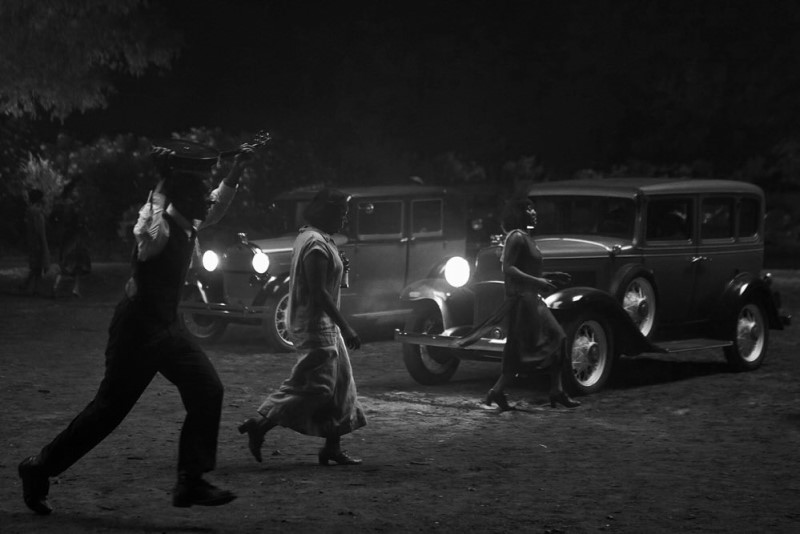
The story follows the “Smokestack twins,” Smoke and Stack, who return to their Southern roots after seven years away — a journey that took them through the trenches of World War I and the violent streets of Al Capone’s Chicago. Their return is driven by an ambition for Black ownership: the opening of a community juke joint. This setting acts as a sanctuary, a “haunted” space where the secular music of the Blues meets the sacred history of a people who have survived centuries of trauma.
Courtesy of Eli Joshua @eli_joshua
In this 1931 landscape, the danger is twofold. While the white Irish vampires lurking in the shadows represent a physical threat, the violent racism of the Jim Crow era, seen in “the Klan,” represents an omnipresent, systemic horror that the twins cannot outrun. The film captures this tension by contrasting the grotty tenements and blood-stained floors with the vibrant, life-affirming energy of the Black community’s art and music.
THE DICHOTOMY OF FAITH: CHURCH AND HOODOO
Religion and spirituality are the primary moral fabric of this world. The setting is divided between the traditional Black church — embodied by a stern Pastor — and the ancestral practices of Hoodoo.

Courtesy of Eli Joshua @eli_joshua
THE SACRED CHURCH
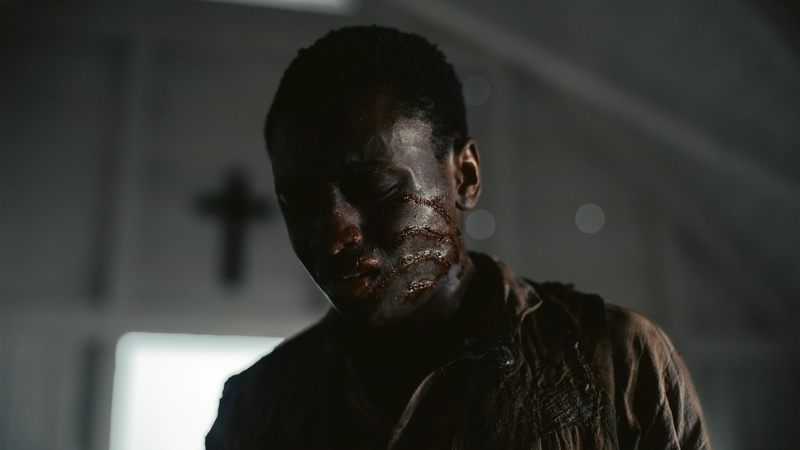
The church is portrayed as both a refuge and a tool of repression. It is a place where the younger generation, represented by the blues-loving Sammie (Miles Caton), is told to renounce their art as sinful and demonic.
Sinners | Warner Bros.
THE ANCESTRAL MOJO
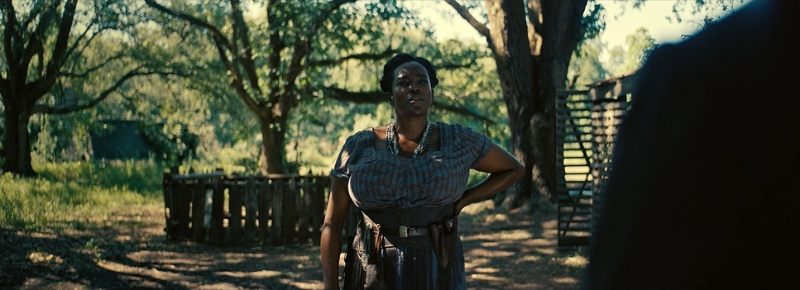
In contrast, characters like Annie (Wunmi Mosaku) represent a thick, dark-skinned hoodoo practitioner whose wisdom and mojo bags are dismissed by the non-believers until the supernatural threat becomes undeniable. This spiritual backdrop illustrates how Christianity was historically weaponized to erase the history and culture of the colonised, while traditional practices offered a secret form of salvation.
Sinners | Warner Bros.
THE BLUES: A BRIDGE THROUGH TIME
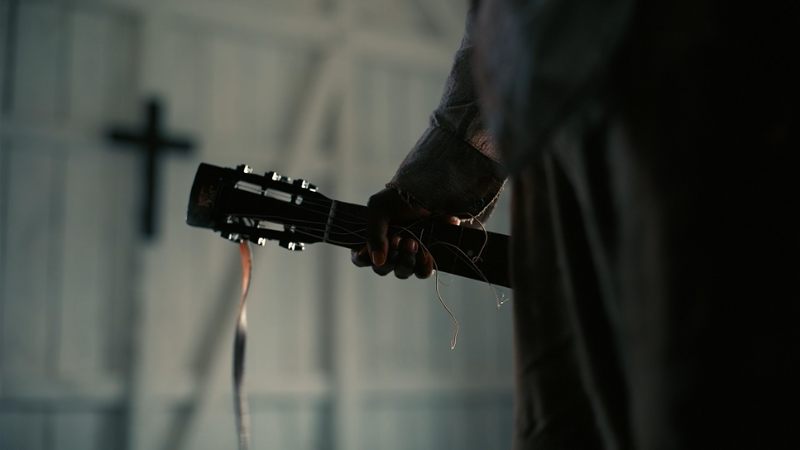
Sinners is a world defined by its sound. The Blues is music so pure it can pierce the veil between life and death, past and future. The film establishes a visual synchronicity between the music and the imagery, where a guitar once believed to belong to Charley Patton summons musicians from the future to dance alongside spirits of the past.
Sinners | Warner Bros.
This musical backdrop connects the 1930s setting to a broader historical timeline of colonization and resilience. The antagonist, the Irish vampire Remmick (Jack O’Connell), is himself a victim of colonization who seeks to exploit Sammie’s raw power to reunite with his own lost community. This creates a cycle of exploitation that mirrors the historical reality of the era.
NATURE AND THE SUPERNATURAL
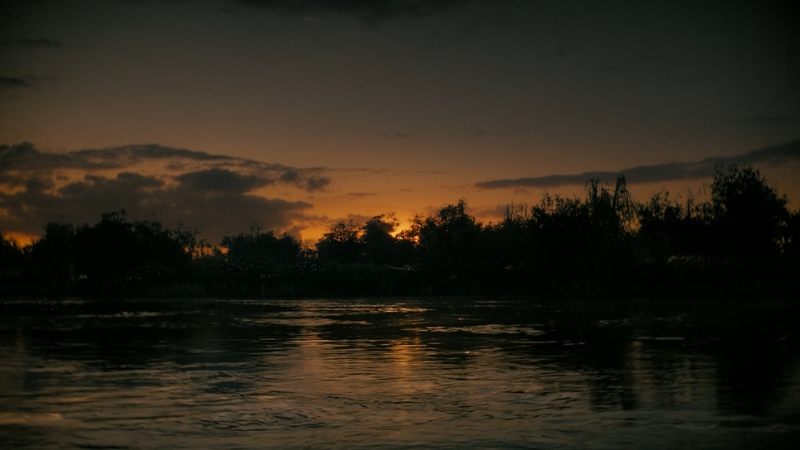
Coogler grounds the supernatural in the real beauty of nature. The Mississippi Delta is rendered as a place where the landscape itself is a witness to history. From enchanted guitars to scarred bodies, every element of the setting is meant to reflect the lived realities of its inhabitants. It is a world where the sun rising over the ice and the blood red of a mother’s dress are part of an operatic tone that tells a story of survival, forgiveness, and the eternal search for a home.
Sinners | Warner Bros.
♩ SINNERS PRODUCTION DESIGN ♭
The production design of Sinners is a monumental achievement in handmade world-building, defined by a complete rejection of existing structures in favor of sets built entirely from the ground up. Led by Oscar-winning production designer Hannah Beachler, a longtime collaborator of Ryan Coogler for over 12 years across five films, the design was tasked with translating the historical weight of the Jim Crow-era South into a truth that feels like fantasy.”
THE “FROM-SCRATCH” PHILOSOPHY AND LOCATION
While the film is set in Clarksdale, Mississippi, the production was shot in neighboring Louisiana to leverage its robust film infrastructure. Beachler utilized locations in Donaldsonville, Braithwaite, and Thibodaux to recreate the Delta, noting that “Louisiana is Mississippi’s neighbor… we have several things in common, from the big fields to the small rural towns and the weather.”
Courtesy of Warner Bros.
Every major setting was constructed from scratch on location to allow for a 360-degree immersive environment. Beachler’s approach was inspired by the exaggerated forms seen in films like Big Fish.
“I assigned them colors of red, white, and blue,” says Beachler. “They each have their own personality, inspired by Dennis Gassner and Tim Burton’s Big Fish, which is very much about these small silhouettes of buildings, leaning and exaggerated in form.”
COLOR CODING AND SYMBOLIC ARCHITECTURE
Beachler utilized a specific color palette to distinguish the film’s moral and social dichotomies.
| WHITE | The Church | Representing piety and traditional institutions. |
| BLUE | Annie’s Abode | Specifically, “haint blue,” a protective shade inspired by Gullah Geechee and enslaved African traditions used to ward off evil spirits. |
| RED | The Juke Joint | Representing blood, capitalism, and the “free spirit” of the community. |
THE JUKE JOINT: A MASTERPIECE OF DISTRESS
The centerpiece of the film, the juke joint, took eight weeks to build. To achieve an authentic, weathered look, the team used boric acid to chemically rust the metal sheets on the exterior.
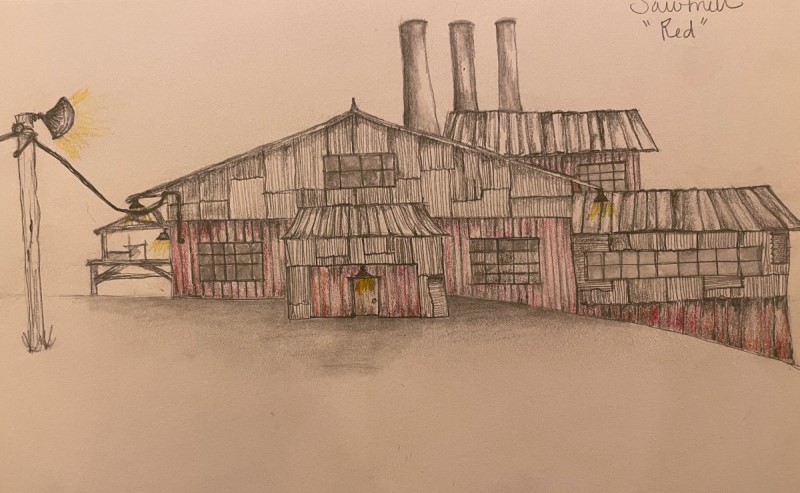
First sketch of the Juke Joint in Sinners by Hannah Beachler
“I wanted to make it two stories, to tell the story that people lived there at one point,” recollects Beachler. “We painted the levels of the equalizer of the song [‘Smokestack Lightning’] in rust on the back wall. We wanted to bring in the feeling that music is surrounding them.”
The production required two separate juke joint sets: one built in Plaquemine Parish for exterior and interior shots — surrounded by real alligators to provide an “old and prehistoric” atmosphere — and a second version built onstage for technical sequences.
THE HOODOO HOUSE: COOL SERENITY OF NATURE

Annie’s Store illustrated by Tessa Wessels
The house owned by Annie, the Hoodoo practitioner, is painted in a haint blue that corresponds with the natural beauty of the Mississippi woods. It’s the corresponds with the sinful lust of the Juke Joint and the purity of the church, sitting in perfect balance between the two.
THE CHURCH: FAITH IN THE DETAILS

Jedidiah’s Church illustrated by Tessa Wessels
The church set, based on the Sunflower Plantation in Clarksdale, was built at the Laurel Valley Plantation. Beachler infused the structure with deep spiritual symbolism and Easter eggs.
NUMERICAL SIGNIFIERS
The wall studs were placed exactly 33 inches apart, a reference to the age Jesus Christ died and a signifier of “the end.”
THE “CROSSED-ARM” RAFTERS
In a subtle nod to Black Panther, the beams supporting the roof were shaped like the “Wakanda Forever” salute.
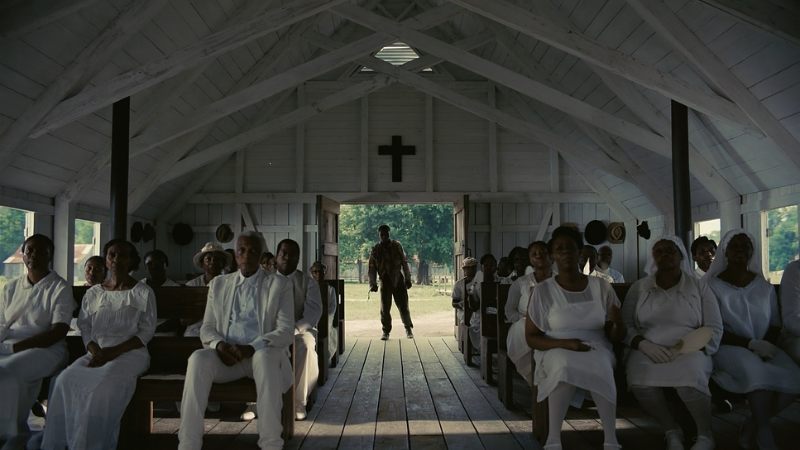
Sinners | Warner Bros.

Black Panther | Disney
IMAX PRECISION
Rafter heights were meticulously calculated so they would disappear into the shadows at the exact height required for the 70mm IMAX frame.
HISTORICAL
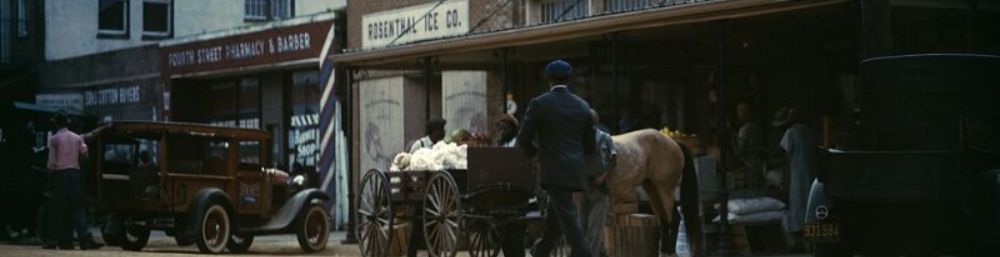
To capture the economic reality of 1932, Beachler designed the main street to highlight the racial divide through consumer access.
THE BLACK SIDE
The grocery store was stocked with working things like hoses, brooms, and buckets. The candy on the Black side is hard, Beachler notes, whereas the white side featured cakes, fruit, and more abundant advertising.
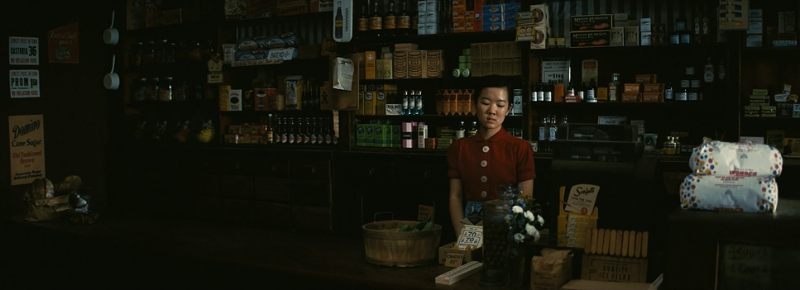
Sinners | Warner Bros.
THE COTTON FIELDS
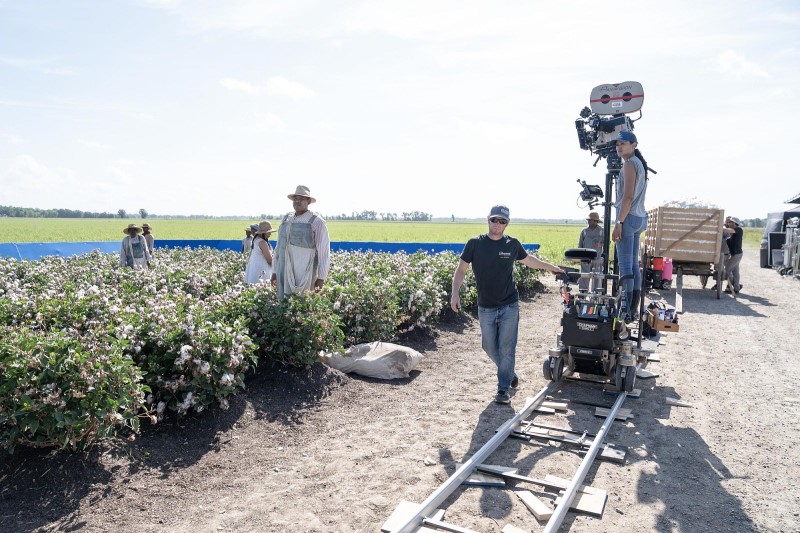
To recreate the “Cotton is King” era, over 1,200 plants were brought in, with crew members hand-tying approximately 3,000 pieces of cotton onto each plant.
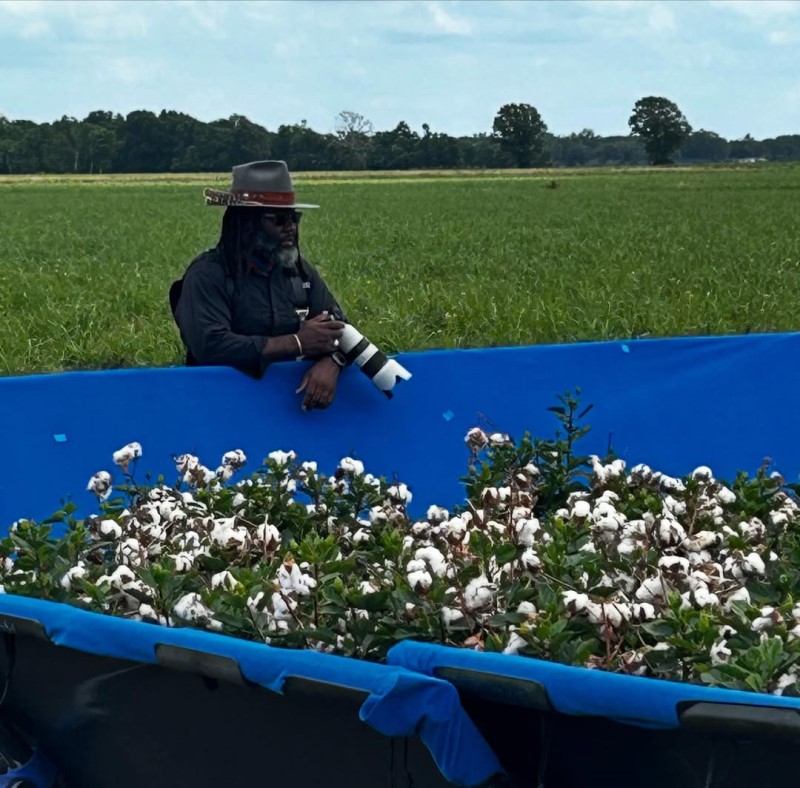
Photo by Eli Joshua @eli_joshua
Ultimately, Beachler’s work was about grounding the supernatural in the wealth of that land and the poverty of the people who worked that land. By focusing on the smallest of details, the production design turned a vampire thriller into a visceral commentary on the station of Black Americans in the Delta.
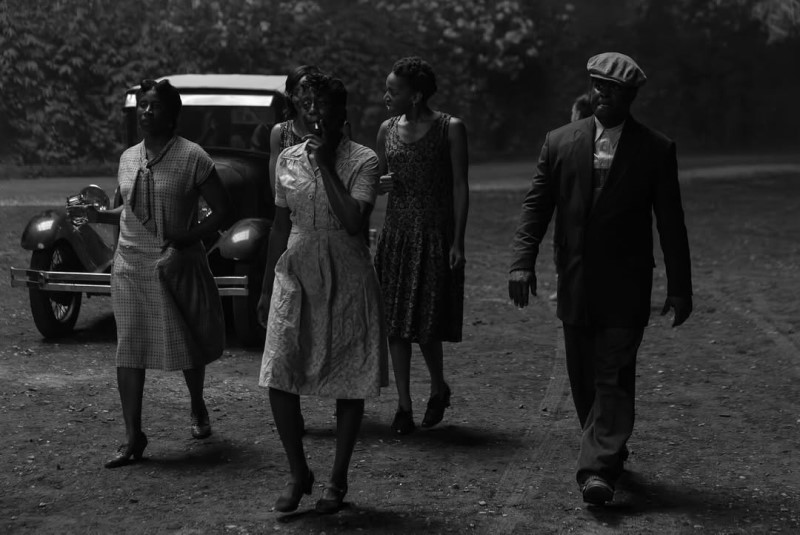
Photo by Eli Joshua @eli_joshua
♩ SINNERS CINEMATOGRAPHY ♭
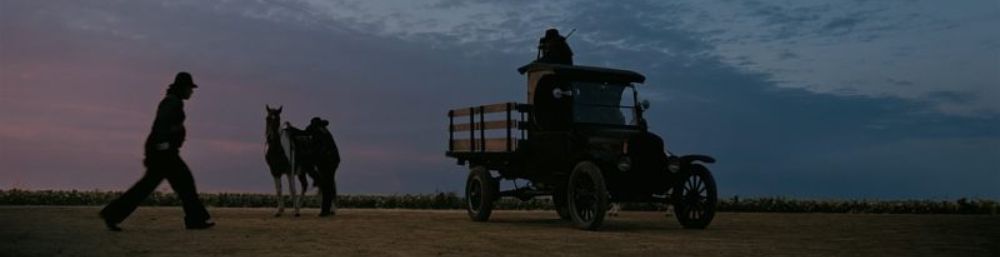
The cinematography of Sinners is a landmark achievement in large-format filmmaking, helmed by Autumn Durald Arkapaw, ASC. An AFI alum (Class of 2009) and Emmy nominee for Loki, Durald Arkapaw has built a career defined by luminous visuals and a signature use of anamorphic lenses on films like Black Panther: Wakanda Forever and The Last Showgirl. With Sinners, she reunited with director Ryan Coogler, making history as the first female cinematographer to shoot a feature film in 65mm IMAX format.
Durald Arkapaw’s approach to the film was deeply personal, as her family roots trace back to Mississippi and New Orleans.
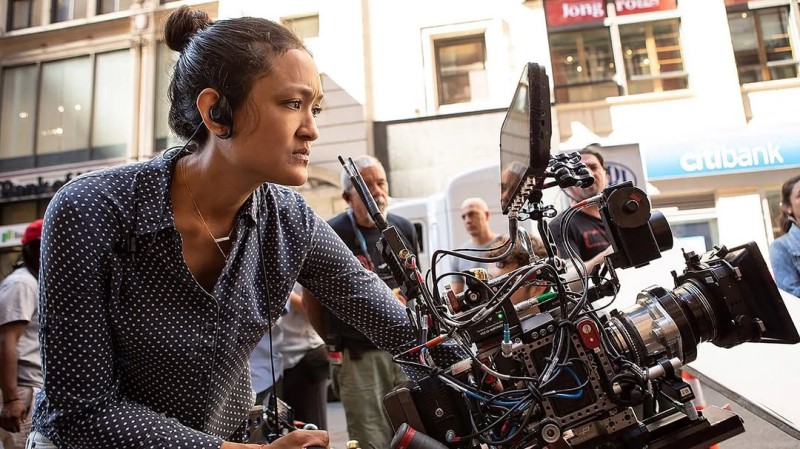
“It was important for me to understand my own history and how it connected to this story,” she remarked, noting that the script’s genre fluidity and emotional depth were unlike anything she had ever read.
Her goal was to honor her ancestors by creating images that felt soulful and dripping with humanity, utilizing the massive canvas of 65mm film not just for spectacle, but for intimacy.
THE LEAP TO LARGE FORMAT: FROM 16MM TO 65MM
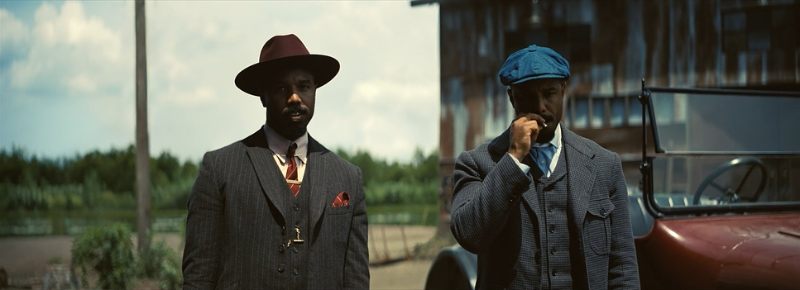
Originally, Ryan Coogler envisioned Sinners as a Super 16mm production, seeking a gritty, intimate period feel similar to their work on Fruitvale Station. However, the technical complexity of Michael B. Jordan playing twins Smoke and Stack required a more stable negative for VFX “twinning” work, shifting the conversation to 35mm.
Sinners | Warner Bros.
The final evolution occurred when the studio suggested large format. Durald Arkapaw set up a screening at FotoKem where she and Coogler watched 70mm prints of 2001: A Space Odyssey, Tenet, and Quentin Tarantino’s The Hateful Eight.
When Coogler saw the depth and scope possible, he stood up in the dark theater and declared, “This is what I’ve been missing.”
This epiphany led to a groundbreaking combination of two distinct aspect ratios in a single film.
2.76:1 (ULTRA PANAVISION 70)
Used to capture the weight of the sky and the vast, flat horizons of the Mississippi Delta, emphasizing the landscape’s oppressive beauty.
1.43:1 (15-PERF IMAX)
Reserved for candid looks into the soul of the character and high-octane action sequences, creating a vertical immersion that pulls the audience deeper into the frame.
 |
 |
CAMERAS, CUSTOM LENSES & “STEEZ”
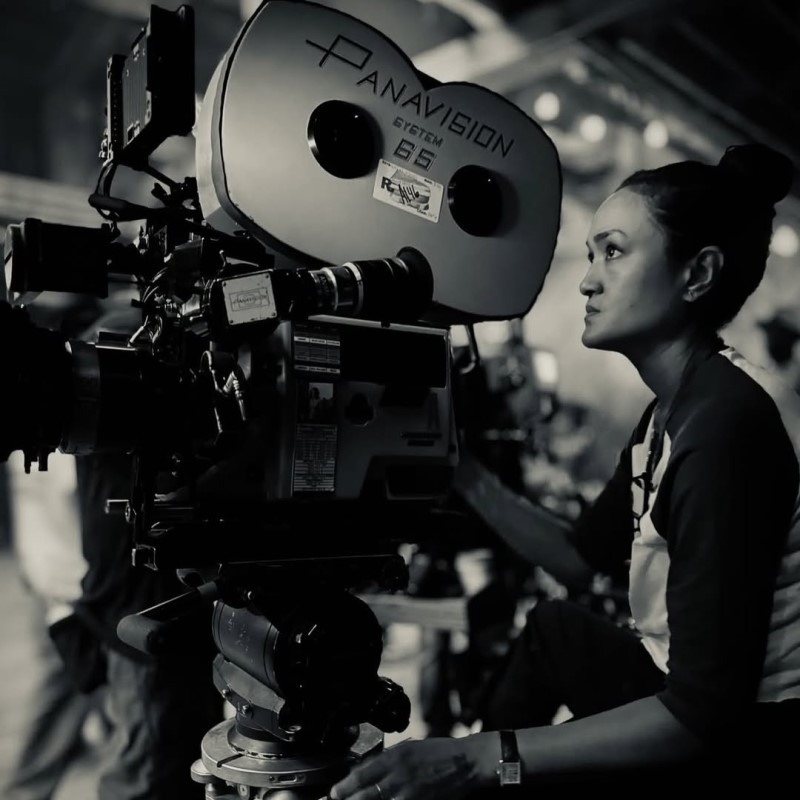
To execute this ambitious vision, Durald Arkapaw curated a heavy-duty arsenal of gear. They collaborated with Panavision’s VP of Optical Engineering, Dan Sasaki, to ensure the optics had “steez”—a term she uses to describe lenses with unique personality and texture.
CAMERAS
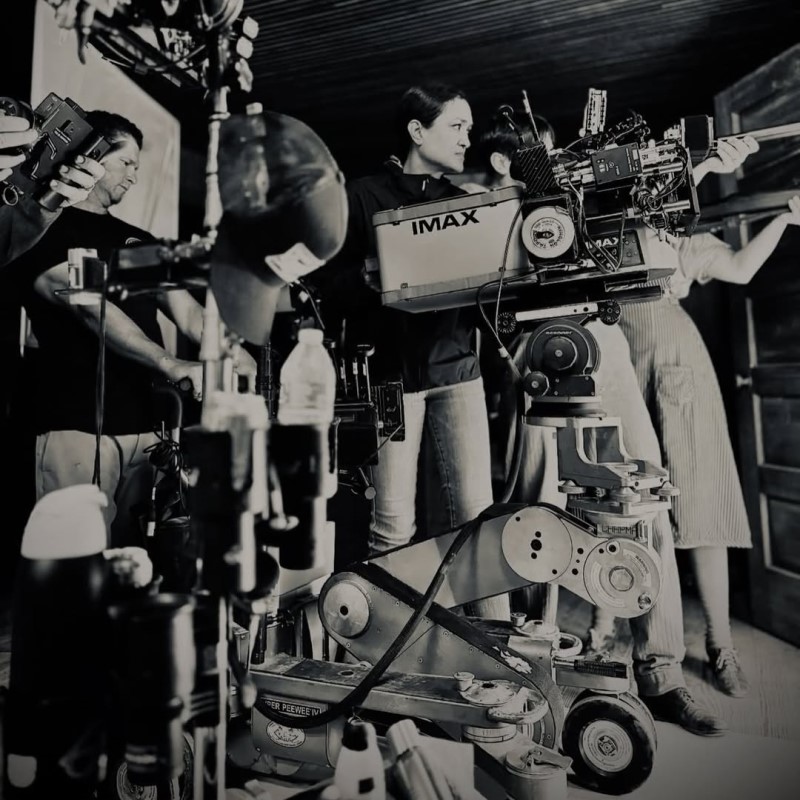
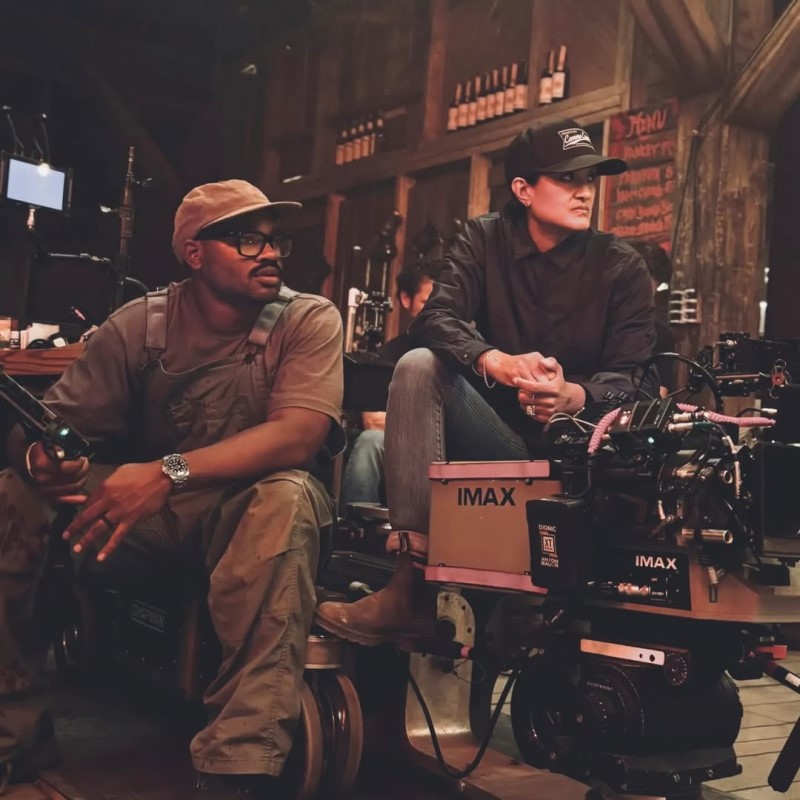
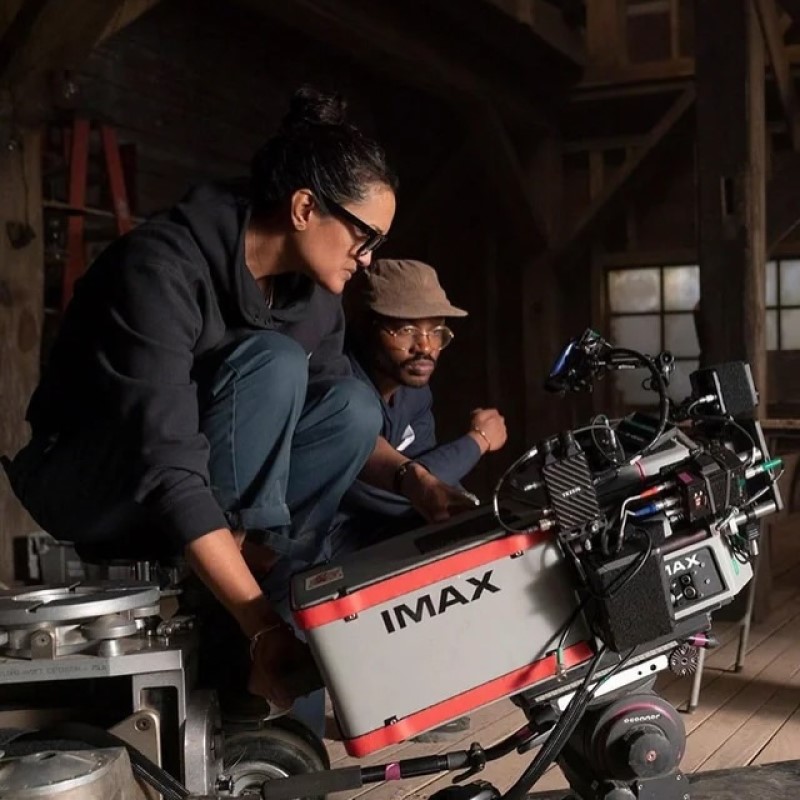
The production utilized Panavision System 65 Studio and High Speed cameras, alongside the massive IMAX MSM 9802 and MKIV film cameras. The IMAX cameras were so heavy (approx. 65 lbs) that Durald Arkapaw likened operating them to carrying a “mini-fridge” on her shoulder.
LENSES
The primary glass included customized Panavision Ultra Panatar 1.3x Anamorphics and Panavision IMAX 50mm and 80mm optics.
THE “DREAM” LENS
Dan Sasaki built a bespoke 80mm IMAX Petzval lens with aggressive field curvature specifically for the film. This lens was used for a dreamlike sequence where Smoke is handed the baby he and Annie lost.

Sinners | Warner Bros.
In post-production, the crew applied this specific lens profile to earlier shots of Annie to create a “visual echo” that deepened the emotional connection between the characters.
FILM STOCK
The movie was shot primarily on KODAK VISION3 500T 5219 for consistency. However, in a historic first, Kodak specially manufactured a batch of 65mm EKTACHROME 100D Color Reversal film for the production. Durald Arkapaw used this vibrant stock to capture handheld “portrait-style” flashback sequences, creating an iconic, saturated look that stands apart from the rest of the film.
 |
 |
THE “HALO RIG” AND TWINNING
Capturing Michael B. Jordan interacting with himself as identical twins required a blend of old-school discipline and cutting-edge technology. Coogler wanted the interactions to feel grounded, avoiding the floaty feeling of digital doubles whenever possible.
SPLIT-SCREEN
For simple dialogue scenes, the team relied on traditional split-screen techniques, filming Jordan twice and locking off the camera.
THE HALO RIG
For complex physical interactions where the twins touch or fight, the crew utilized an innovative Halo Rig. This device is a harness wrapped around Jordan’s face, equipped with an array of 10 to 12 cameras to record his performance from every conceivable angle.
As Durald Arkapaw notes, “The Halo Rig was not used to capture actual shots in the film,” however, “it is just a rig with small digital cameras used to capture reference material of MBJ’s performance in existing lighting situations.” To sum it up, the Halo Rig assisted the team in accurately creating any head replacement shots.
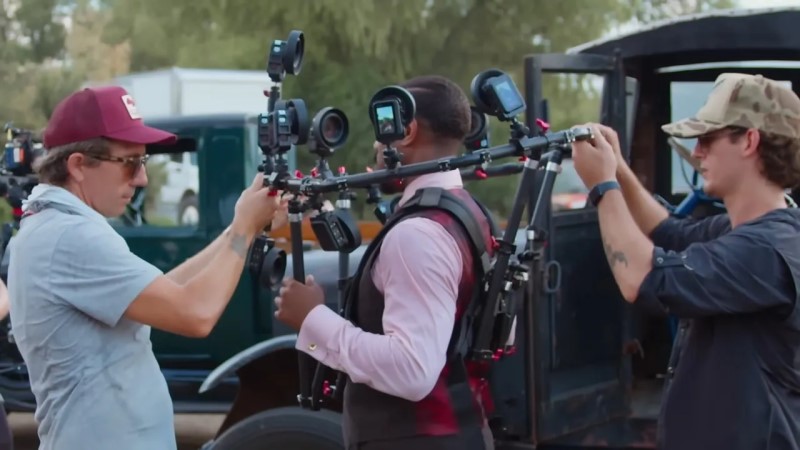
Photo courtesy of Warner Bros.
This comprehensive 3D capture was then superimposed onto a stunt double’s body using machine learning. This allows for complex, tactile interactions that maintain the actor’s nuanced performance.
THE “SURREAL” JUKE JOINT MONTAGE
One of the film’s most celebrated sequences is the Surreal Montage inside the juke joint. As Sammie performs “I Lied to You,” the room transforms, filling with dancers from the past, present, and future of Black music — from tribal dancers to hip-hop artists.
THE LIGHTING
To allow the camera 360-degree freedom, Durald Arkapaw and gaffer Brian Bartolini lit the set almost entirely from above. They used Jem Balls (19, 22, and 30-inch) fitted with tungsten bulbs and double-diffused with unbleached muslin to create a soft, period-appropriate glow. Above the set, 70 ARRI SkyPanel S60s provided a cool moonlight ambience.
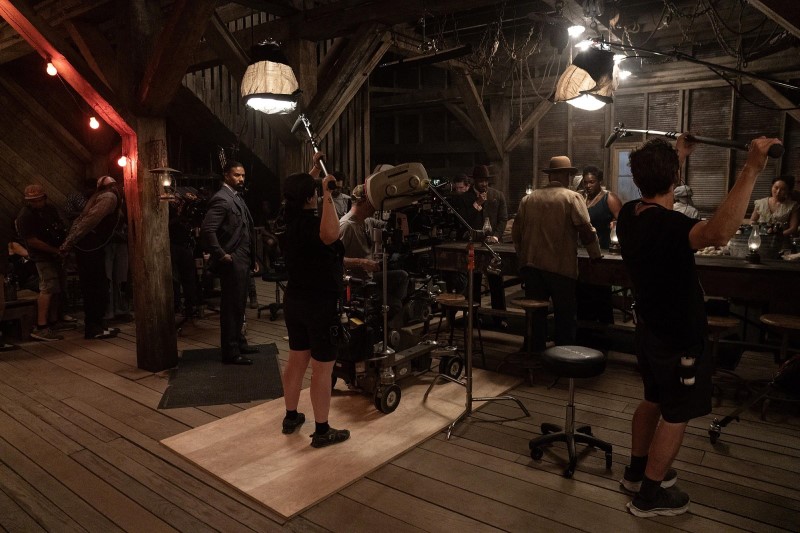
Courtesy of Warner Bros.
THE SHOT
The sequence was shot in a single day as a complex oner. Durald Arkapaw navigated the heavy IMAX camera on a Steadicam, weaving through the crowded dance floor.
THE TRANSITION
The shot begins in reality and transitions into the surreal as the camera tilts up to the roof, which appears to burn away (a VFX takeover based on a real burning roof plate shot on the final day of production). It culminates in a massive 50-foot Technocrane pull-back revealing the vampires watching from the woods.

Sinners | Warner Bros.
“It was a beautiful scene that Ryan wrote,” Durald Arkapaw reminisces. “Everyone was very inspired by it ’cause it had so much meaning. Ryan is so specific about representing different cultures… It’s all departments working together on a very high level.”
ON SET: “DRIVE IT LIKE YOU STOLE IT”
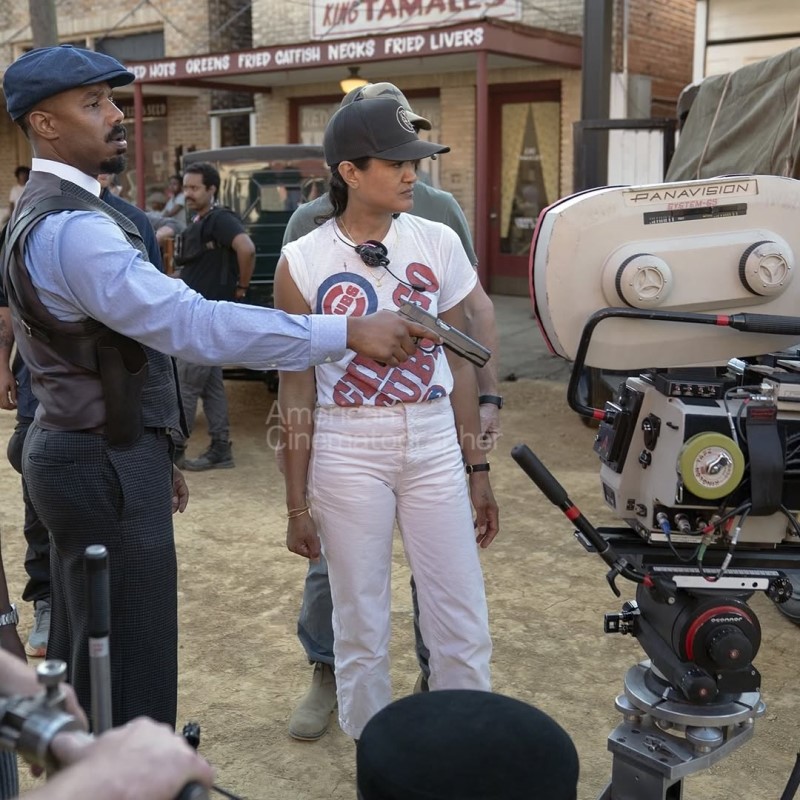
The physical demand of the shoot was immense. The crew braved 100°F temperatures and 80% humidity in Louisiana, treating the massive, noisy IMAX equipment like run-and-gun documentary cameras. During prep, Durald Arkapaw sought advice from Oppenheimer DP Hoyte van Hoytema, who famously told her:
 |
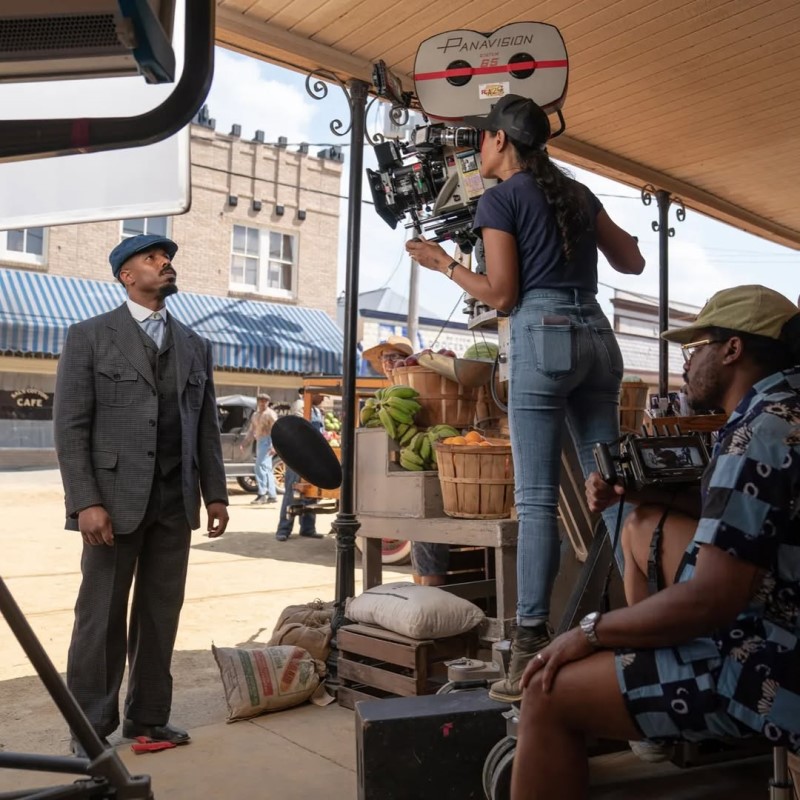 |
“Drive it like you stole it, advises Durald Arkapaw. “Don’t let the fact that the format and the cameras are bigger than you’ve shot before… feel like it’s cumbersome. Shoot like you normally would.”
THE MAGIC HOUR JAM
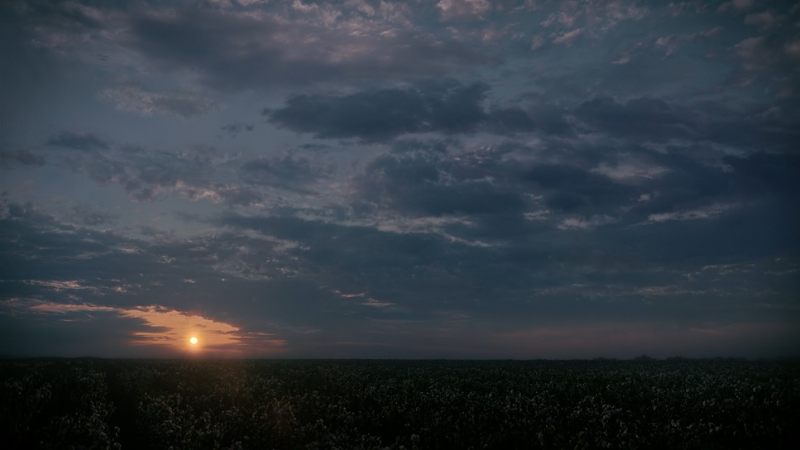
This philosophy was tested during a critical Western-inspired sequence involving the vampire Remmick’s grand entrance. The shot required Remmick to jump off a box (hinting at flight) while the sun set perfectly behind him. With only two days allotted for the scene and the light fading fast, disaster struck.
Sinners | Warner Bros.
“The IMAX camera jammed right before we were about to shoot that one shot of him looking at the sun on the horse… But we were able to fix the jam, and we literally rolled right before it set.” —Autumn Durald Arkapaw
The resulting footage captures the sun breaking the horizon at the exact moment needed for the story. This exemplifies the crew’s ability to wrangle the beast of large-format film under extreme pressure.

Become a member of Filmmakers Academy to master the art of cinematography!
♩ SINNERS COSTUME DESIGN ♭

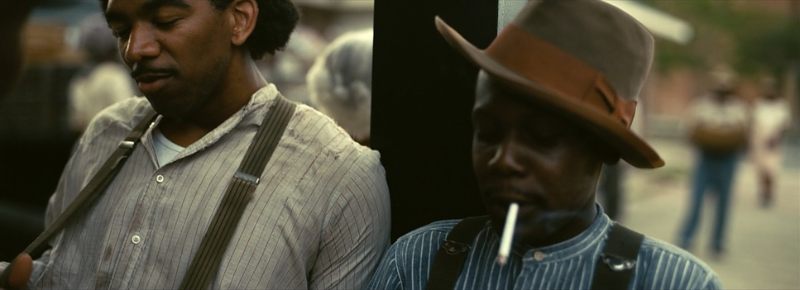
The costume design of Sinners is a rich tapestry of history, mysticism, and Americana, brought to life by two-time Academy Award-winner Ruth E. Carter. Having already cemented her legacy with Afrofuturist masterpieces like Black Panther and Wakanda Forever, Carter approached Sinners with a mission to honor her own Southern roots.
Inspired by her upbringing and her studies at Hampton University, she treated the wardrobe not merely as clothing, but as a visual story that connects the African past to the American South.
Sinners | Warner Bros.
For Carter, this project was deeply personal.
“I look at history and look at the pictures of all of these blues greats… how could you not be influenced by all that richness?” Carter remarks.
Her designs for the film were grounded in authenticity, utilizing no-tailoring rules for background actors to ensure clothes looked lived-in and hand-me-down, reflecting the economic reality of 1930s sharecroppers.
SMOKE AND STACK: A TALE OF TWO SUITS
Michael B. Jordan’s dual performance as twins Smoke and Stack required a costume strategy that was distinct yet cohesive. Both characters wear wool suits — a nod to their migration from Chicago back to the sweltering South — but the details define their personalities.
STACK
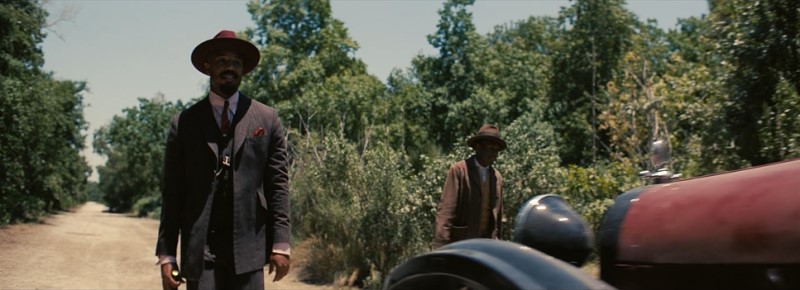
The “swaggering troublemaker” wears a tailored, 1920s-cut suit with a three-button front, tie bar, collar bar, and matching pocket square. His hat, a specific red fedora sourced from a vintage shop on Melrose, was so precious it had its own leather carrying case.
Sinners | Warner Bros.
SMOKE
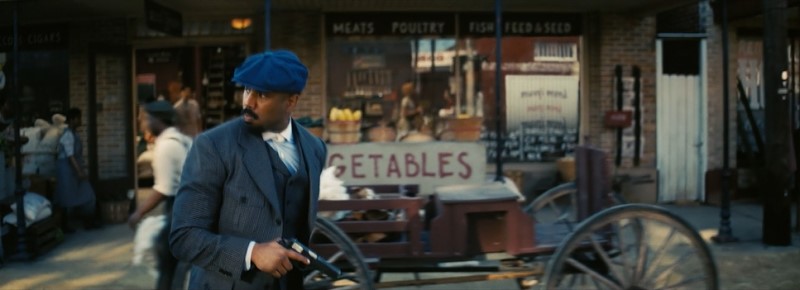
The “salt-of-the-earth” brother wears a boxier, less tailored suit with a tieless, buttoned-in collar. His look is designed to hide two guns and a knife, embodying a man ready for action. Carter gave him a blue denim flat cap to represent his connection to workwear and the “everyman.”
Sinners | Warner Bros.
To manage the grueling schedule where Jordan changed between characters up to four times a day, Carter’s team, led by costumer Mustapha Mimis, meticulously tracked every layer, from pristine wool to blood-spattered tank tops.
ANNIE: SPIRITUAL ARMOR
For the character of Annie, the community’s hoodoo practitioner, Carter avoided clichés of turbans and shawls. Instead, she designed a look rooted in “spiritual armor.”
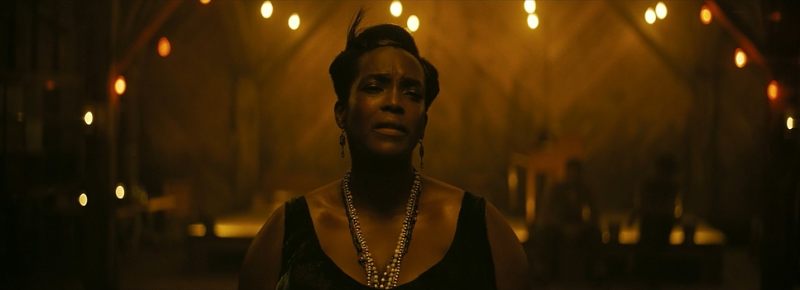
Sinners | Warner Bros.
HAINT BLUE
Annie wears a skirt dyed in haint blue, a color traditionally used by Gullah Geechee people to ward off evil spirits.
THE DETAILS
Her wardrobe includes a leather belt with pouches for roots, healing oils, and a knife. Underneath, she wears prayer beads that serve as protection, not fashion.
“It was very important — to make her a spiritual force, a feminine woman, a mothering soul, but also independent,” Carter explained.
THE SURREAL JUKE JOINT MONTAGE
The film’s centerpiece is a time-bending musical sequence where the past, present, and future collide on the dance floor. Carter’s designs for this scene had to bridge centuries of Black culture.
THE ENSEMBLE
The scene features a West African Griot, a 1970s Jimi Hendrix-style guitarist, a 1990s hip-hop dancer, and ancestral spirits.
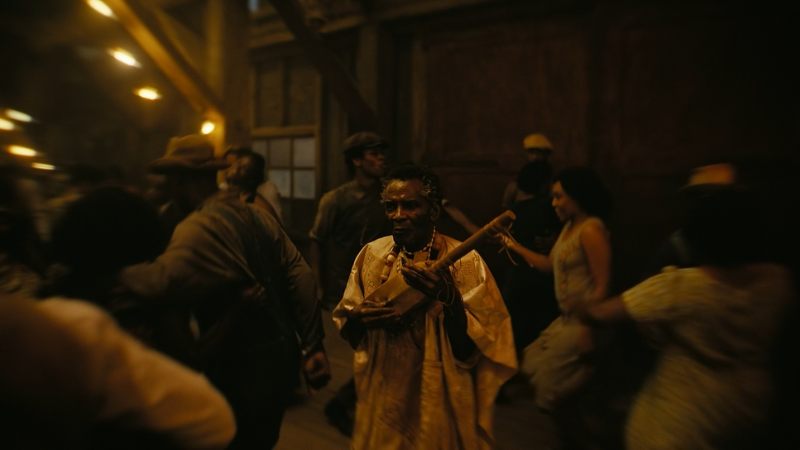
Sinners | Warner Bros.
THE “FUTURE” SPIRITS
Dancers representing the future wore avant-garde, Erykah Badu energy outfits with slatted dresses, while a Zouli dancer wore a massive, authentic mask supported by a football helmet stem.
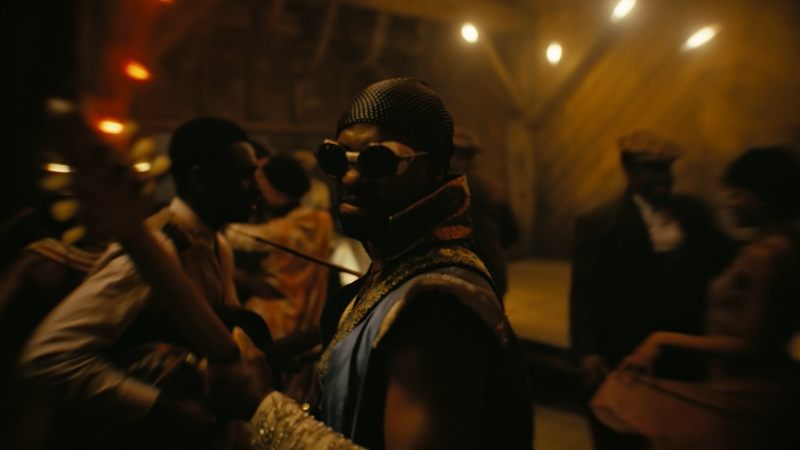
Sinners | Warner Bros.
AUTHENTICITY
Carter even sourced a vintage sweat suit identical to the one LL Cool J wore for a hip-hop dancer, ensuring every era was represented with historical accuracy.
THE BLADE CONNECTION
In a twist of Hollywood fate, Sinners benefited from the delay of Marvel’s Blade reboot. Carter had already begun prepping a 1920s-era wardrobe for Blade when the project stalled due to strikes. With a warehouse full of period-appropriate clothing sitting unused, Sinners producer Sev Ohanian negotiated with Marvel to purchase the stock at cost. This generous deal allowed Carter to dress the film’s massive background cast in high-quality, period-authentic attire immediately.
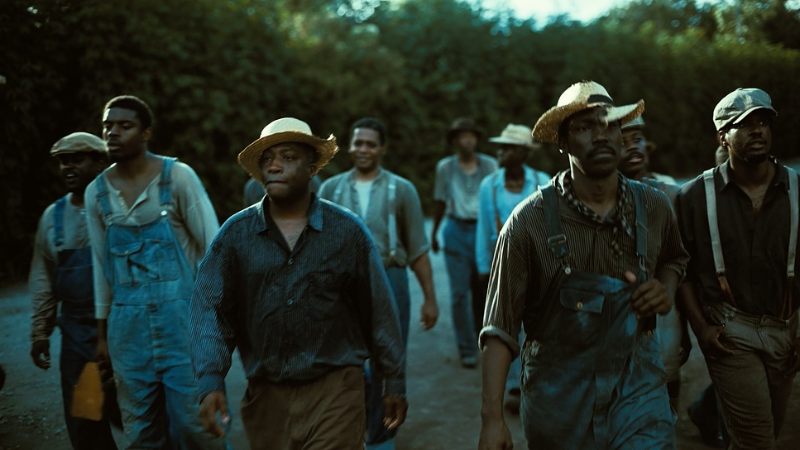
Sinners | Warner Bros.
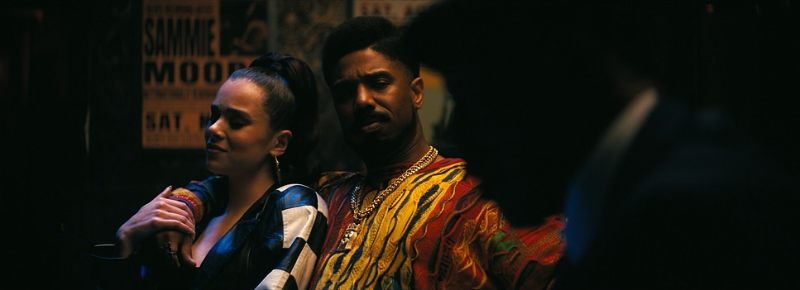
THE POST-CREDITS 90S STYLE
For the post-credits scene set in the 1990s, Carter leaned into iconic cultural touchstones.
Sinners | Warner Bros.
THE COOGI SWEATER
Stack is seen wearing an authentic Coogi sweater — the “Gambler” model made famous by Biggie Smalls — loaned from a collector in Los Angeles who keeps a storage unit filled with pristine 90s gear.
MARY’S LOOK
Hailee Steinfeld’s character dons a cropped leather jacket and bamboo earrings inspired by Paula Abdul, capturing the quintessential vibe of the era.
♩ SINNERS HAIR & MAKEUP ♭
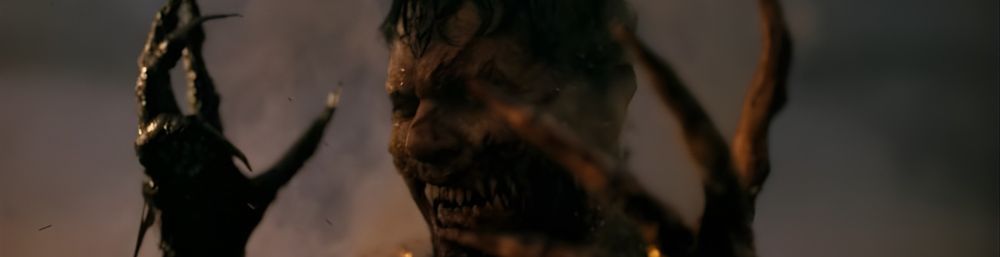
The immersive world of Sinners relies heavily on the transformative power of its hair and makeup department. The film’s aesthetic balances two distinct extremes: the grounded, humid reality of 1930s Mississippi and the visceral, gnarly horror of the supernatural. This duality was achieved through the collaboration of Prosthetic Makeup Designer Mike Fontaine and Key Hairstylist Tené Wilder, who worked to ensure the characters looked as authentic in the pews of a church as they did tearing through flesh in a juke joint.
PROSTHETICS: VISCERAL HORROR AND “THE THING”
Ryan Coogler recruited Mike Fontaine after seeing his brutal work on Jeremy Saulnier’s Green Room. Coogler’s brief was specific: he wanted practical effects that left a mark.
“I hadn’t been that viscerally moved by makeup since I saw The Thing,” Coogler notes.
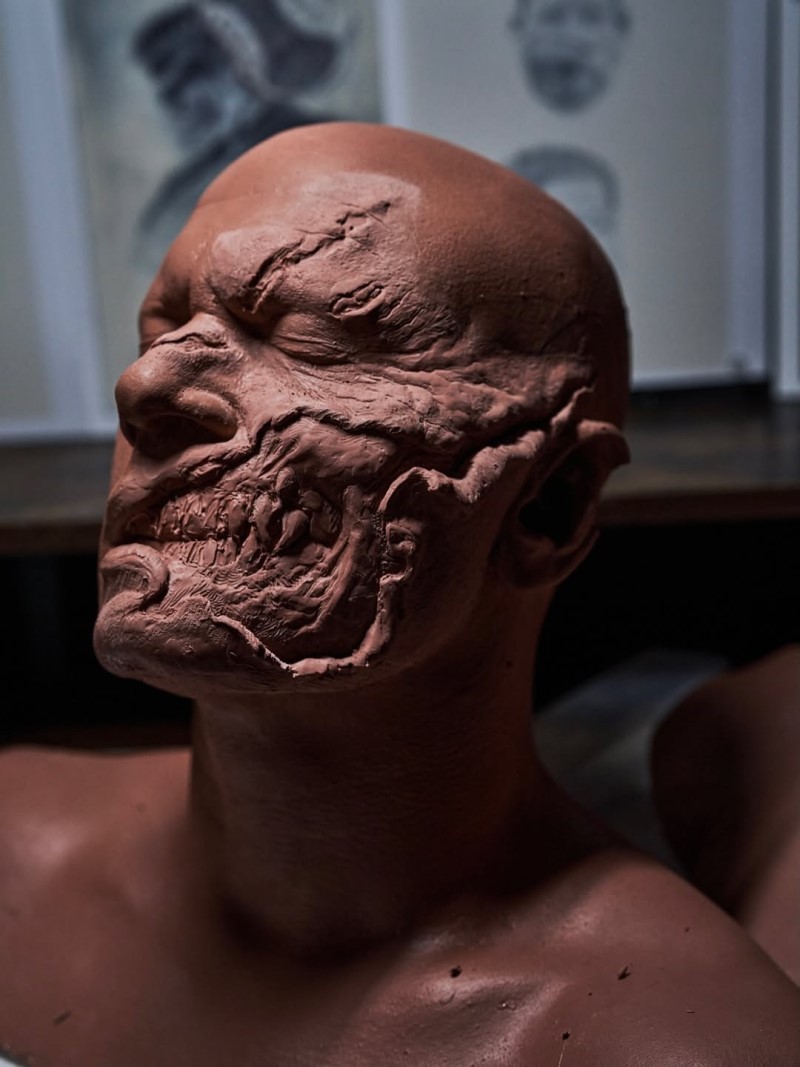
He tasked Fontaine with creating a creature design that felt grounded yet otherworldly. This led to a months-long process of evolving sketches into paintings and finally into physical sculptures.
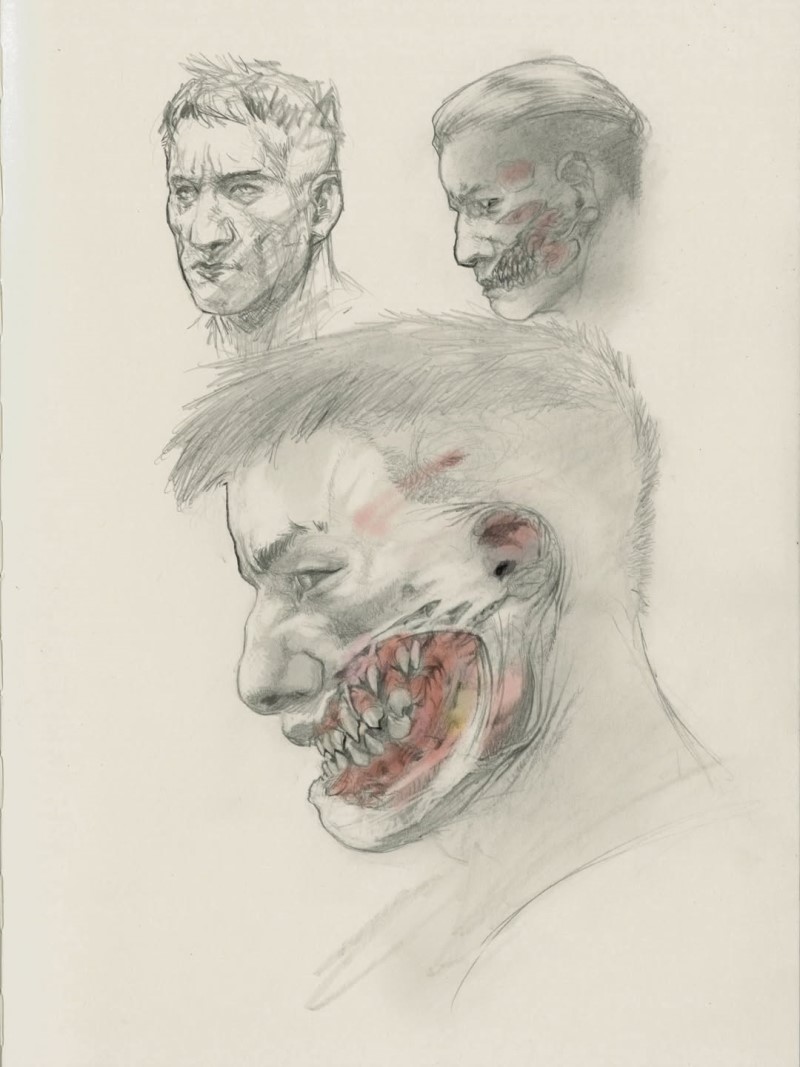
CREATING REMMICK
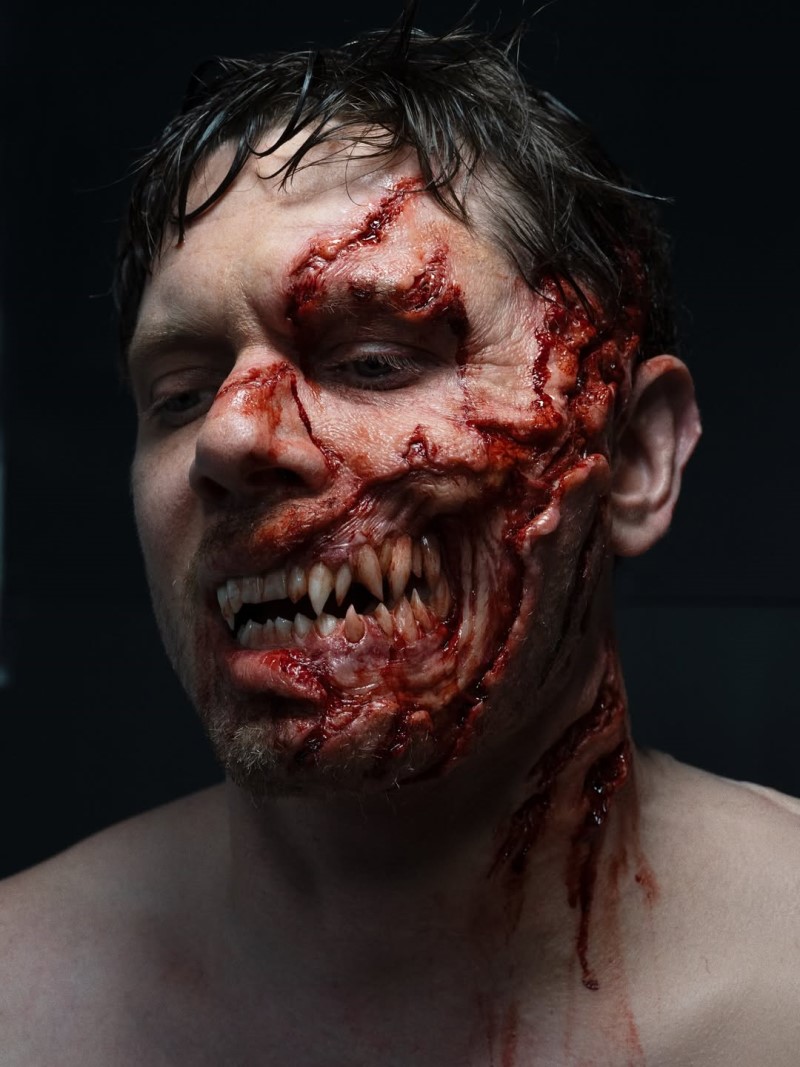
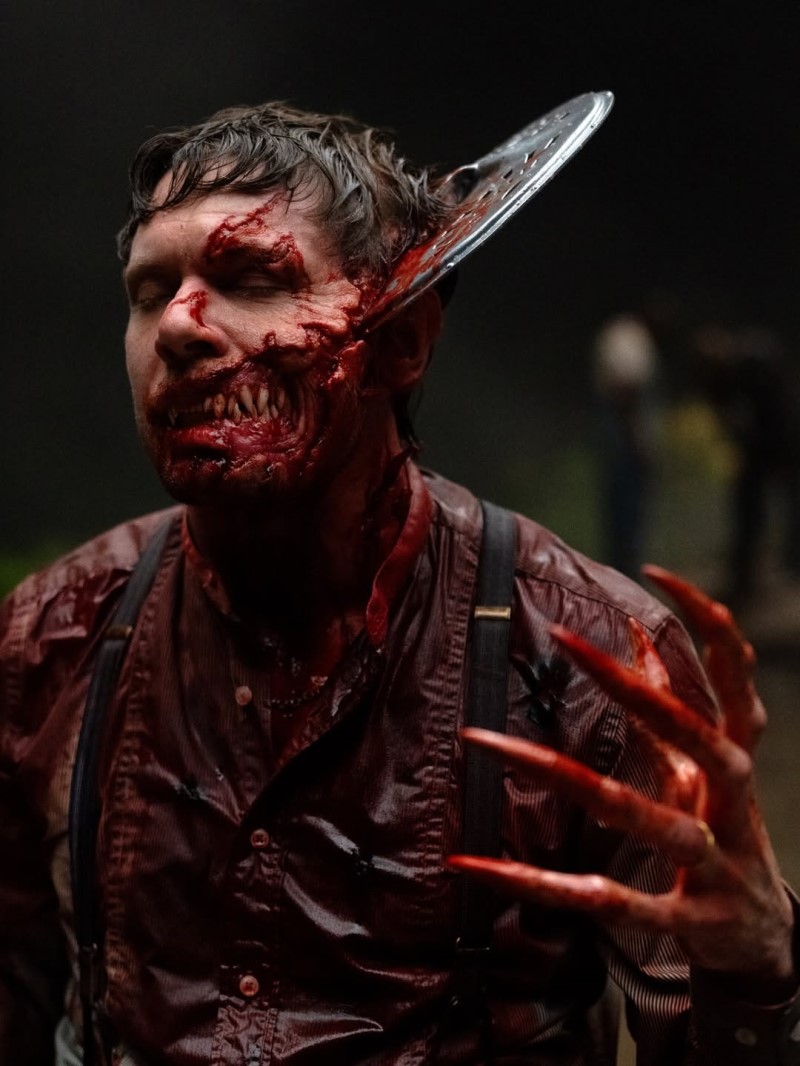
One of the film’s most terrifying feats of practical makeup is the transformation of the vampire Remmick. Coogler wrote a specific sequence where Remmick’s face is ripped open on camera, revealing a physiological twist: his molars are actually his fangs.
Fontaine faced a significant technical paradox:
“Makeup is an additive process, so it’s really tricky to make it seem like someone’s face is actually missing.”
 |
 |
 |
 |
Photos Courtesy of Mike Fontaine
To solve this, the team collaborated with concept artist Carlos Huante and Bitemakers, who created specialized dentures that overlapped O’Connell’s real face. The resulting application created the illusion of a hollowed-out, skeletal structure without the use of digital replacement, anchoring the horror in physical reality.
HAIR DESIGN: BATTLING THE DELTA HUMIDITY
Key Hairstylist Tené Wilder was tasked with defining the period look of the 1930s Jim Crow South. Working alongside department head Shunika Terry, Wilder’s challenge was not just historical accuracy, but durability. Shooting on location in Louisiana meant battling extreme humidity while maintaining intricate period styles.
Wilder’s approach was character-driven, ensuring the hairstyles reflected the narrative arc and social standing of the women in the film:
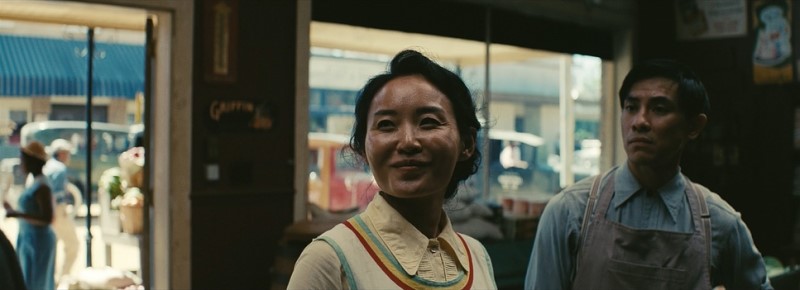
GRACE CHOW (LI JUN LI)
To reflect her status as a pragmatic business owner, Grace sported a pinned-up style.
Sinners | Warner Bros.
“She was a working lady, so of course she would have it up,” Wilder explained.
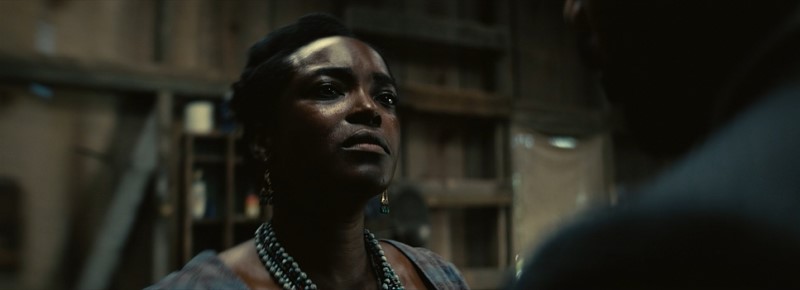
ANNIE (WUNMI MOSAKU)
Her hair was designed to underscore her role as a spiritual anchor in the community, favoring a natural, grounded aesthetic.
Sinners | Warner Bros.
For Wilder, the goal was to create an environment where actors could disappear into their roles without distraction.
“I just want the person to feel as comfortable as they are — in their skin [with] what they have,” says Wilder.
This philosophy grounded the film’s fantastical elements in a tangible, human reality.
♩ WATCH SINNERS ♭

Sinners transcends a vampire thriller through the power of cinematic heritage. By looking backward — to the chemical grain of 65mm film, the architectural silhouettes of the 1930s, and the spiritual armor of hoodoo — Ryan Coogler and his team have created a vision of the future of filmmaking. It is a future where technology serves humanity, where the spectacle of IMAX is used to capture the intimate landscape of a soul, and where the most terrifying monsters are grounded in the tangible reality of history.
Sinners is currently available to stream on major platforms and is available for digital purchase.
Experience the “surreal” juke joint sequence and the immersive scope of the Mississippi Delta on the biggest screen you can find.
JOIN OUR MEMBERSHIP TO LEARN FROM INDUSTRY PROFESSIONALS!
WORKS CITED:Phillips, Maya. “The Symbolism in ‘Sinners.’” The New York Times, 26 Apr. 2025, www.nytimes.com/2025/04/26/movies/sinners-symbolism.html. Pushpakanthan, Suvi. “The Impact of Colonisation Shown Through Sinners.” Inspire the Mind, 8 July 2025, www.inspirethemind.org/post/the-impact-of-colonisation-shown-through-sinners. Sesali. “Sinners Clocked The Meaning Of Who & How Black Men Choose.” Bad Fat Black Girl, 21 Apr. 2025, badfatblackgirl.substack.com/p/sinners-clocked-the-meaning-of-who. Siafa, Lazarus. “Myth, Metaphor, and Meaning: A Deep-dive Into The Overwhelming Symbolic Architecture in ‘Sinners.’” Medium, 21 Apr. 2025, lazarussiafa.medium.com/myth-metaphor-and-meaning-a-deep-dive-into-the-overwhelming-symbolic-architecture-in-the-movie-24e39197990d.
PRODUCTION DESIGNBeachler, Hannah. Interview by Susannah Edelbaum. “Sinners Production Designer Hannah Beachler on Conjuring Ryan Coogler’s Supernatural Stunner.” Motion Pictures Association, 12 May 2025, www.motionpictures.org/2025/05/sinners-production-designer-hannah-beachler-on-conjuring-ryan-cooglers-supernatural-stunner/. Beachler, Hannah. Interview by Jazz Tangcay. “Sinners Production Designer Hannah Beachler on Weaving in Folklore, History and Spirituality Into Her Sets.” Variety, 2025, variety.com/2025/artisans/festivals/sinners-production-design-folklore-history-sprituality-1236547060/. Roby, India. “Sinners’ Production Designer Takes AD Inside the Making of Ryan Coogler’s Vampire Thriller.” Architectural Digest / Yahoo Entertainment, 9 May 2025, www.architecturaldigest.com/story/sinners-production-designer-takes-ad-inside-the-making-of-ryan-cooglers-vampire-thriller.
CINEMATOGRAPHYAFI. “Spotlight on SINNERS Cinematographer Autumn Durald Arkapaw.” American Film Institute, April 2025, www.afi.com/news/spotlight-on-sinners-cinematographer-autumn-durald-arkapaw/. Bahr, Lindsey. “‘Sinners,’ shot on IMAX film, is a historic first for female cinematographers.” AP News, 18 Apr. 2025, apnews.com/article/sinners-cinematographer-2e0c37c4df691228386294c280efc0fc. Desowitz, Bill. “Autumn Durald Arkapaw Is the First Woman DP to Shoot in IMAX — with ‘Sinners,’ It’s 65mm on Steroids.” IndieWire, 19 Apr. 2025, www.indiewire.com/features/craft/sinners-cinematography-imax-65mm-ultra-panavision-70-1235114850/. Hellerman, Jason. “How Did ‘Sinners’ Pull Off Those Twin Shots?” No Film School, 8 May 2025, nofilmschool.com/sinners-twin-shots. Kodak. “Autumn Durald Arkapaw ASC created an immersive experience shooting KODAK large format 65mm film for Ryan Coogler’s sensational ‘Sinners’.” Kodak Motion Picture Blog, 13 May 2025, www.kodak.com/en/motion/blog-post/sinners/. No Film School. “Here’s Why ‘Sinners’ Cinematographer Autumn Durald Arkapaw Shot the Film in 65mm.” No Film School, 15 Jan. 2026, nofilmschool.com/sinners-cinematography-discussion. Tangcay, Jazz. “How ‘Sinners’ Cinematographer Pulled Off That Surreal Juke Joint Music Sequence.” Variety, 2025, variety.com/2025/artisans/news/sinners-cinematography-juke-joint-music-1236369907/. Tangcay, Jazz. “‘Sinners’ Cinematographer Autumn Durald Arkapaw on Shooting Jack O’Connell’s Grand Entrance During Magic Hour.” Variety, 2025, variety.com/2025/artisans/news/sinners-cinematographer-jack-oconnell-entrance-imax-1236558441/.
COSTUME DESIGNCarter, Ruth E. Interview by Bianca Betancourt. “How Ruth E. Carter Resurrected 1930s Southern Style for Sinners.” Harper’s Bazaar, 24 Apr. 2025, www.harpersbazaar.com/culture/film-tv/a64567733/sinners-ruth-e-carter-costumes-interview-2025/. Carter, Ruth E. Interview by Jack Giroux. “Pinstripes and Blood Spatter: Costume Designer Ruth E. Carter on Making Dark Magic in ‘Sinners’.” Motion Pictures Association, 8 May 2025, www.motionpictures.org/2025/05/pinstripes-and-blood-spatter-costume-designer-ruth-e-carter-on-making-dark-magic-in-sinners/. Carter, Ruth E. Interview by Jailynn Taylor. “Ruth E. Carter On Building The Costumes In Sinners And Paying Homage To 1930s Black Southern Style.” Essence, 1 May 2025, www.essence.com/fashion/ruth-e-carter-sinners-costume-design/. Carter, Ruth E. Interview by Jazz Tangcay. “‘Sinners’: Ruth E. Carter on How Historical Photography Inspired Her Costume Designs.” Variety, 2025, variety.com/2025/artisans/news/sinners-ruth-carter-costume-design-history-1236603495/. Fleming, Ryan. “‘Sinners’ Star Wunmi Mosaku & Costume Designer Ruth E. Carter On Crafting Annie As Both A ‘Spiritual Force’ & An Independent Woman.” Deadline, 26 Nov. 2025, deadline.com/video/sinners-wunmi-mosaku-ruth-e-carter-costumes-the-process/. Isaacs, Jordyn Kaila. “The Spirit in the Stitch: How Costume Designer Ruth E. Carter Channels Ancestral Memory, Black Mysticism in Ryan Coogler’s Sinners.” Hampton University Blog, 21 May 2025, home.hamptonu.edu/blog/2025/05/21/the-hampton-script-the-spirit-in-the-stitch-how-costume-designer-ruth-e-carter-channels-ancestral-memory-black-mysticism-in-ryan-cooglers-sinners/. Spencer. “Sinners with Costume Designer, Ruth E. Carter.” The Art of Costume Podcast, 13 May 2025, theartofcostume.com/2025/05/13/sinners-with-costume-designer-ruth-e-carter-the-art-of-costume-podcast/. Stenzel, Wesley. “Sinners repurposed ‘a warehouse full’ of period costumes from Marvel’s stalled Blade movie.” Entertainment Weekly, 5 July 2025, ew.com/sinners-used-period-costumes-from-stalled-blade-movie-for-marvel-11767022. Zilko, Christian. “‘Sinners’ Used Costumes Designed for Marvel’s ‘Blade’ Reboot.” IndieWire, 4 July 2025, www.indiewire.com/news/general-news/sinners-used-costumes-blade-reboot-1235136858/.
HAIR & MAKEUPCase, Wesley. “With ‘Sinners’ Oscar nod, this Baltimore-born hairstylist is earning her own close-up.” The Banner, 22 Jan. 2026, www.thebanner.com/culture/film-tv/tene-wilder-sinners-oscars-hairstylist-pose-emmys-XJUTWO34SRFULI6CQT7WNQ4PRM/. Fontaine, Mike (@mikefontaine_). “Creating Remmick: One of my favorite makeups from SINNERS.” Instagram, 2025, www.instagram.com/p/DUG-wzdkWCy/?hl=en&img_index=1. Sullivan, Kevin P. “‘Sinners’ bonus feature: See how the gnarly makeup effects came to life.” Gold Derby, 6 June 2025, www.goldderby.com/film/2025/sinners-makeup-behind-the-scenes/. |