Space on film has suffered from a chronic case of digital sterility. For the last two decades, interstellar blockbusters have leaned heavily into cold blues, desaturated grays, and the clinical perfection of the digital sensor.
Then came Project Hail Mary.
Directed by Phil Lord and Christopher Miller, and based on the best-selling novel by Andy Weir, the 2026 film has not only raked in a staggering $420.7 million at the box office, but it has completely rewritten the visual playbook for the science fiction genre. Starring Ryan Gosling as Ryland Grace—a science teacher thrust into an interstellar mission to save a dying Earth alongside an alien companion named Rocky—the film thrives by grounding the extraordinary in tactile reality.
GREIG FRASER AND THE PUSH FOR PRACTICAL SCI-FI
At the helm of this visual shift is Academy Award-winning cinematographer Greig Fraser, ASC, ACS. Partnering with colorist David Cole and utilizing Fotokem’s proprietary SHIFT dual film-out process, Fraser engineered a look that shatters the stereotypical visuals of deep space. Instead of relying on a cold, digital vacuum, the team injected the film with deep, warm oranges and an undeniable analog patina. They embraced the texture, grit, and humanity of ’70s and ’80s classics like Alien, 2001: A Space Odyssey, Solaris, and Close Encounters of the Third Kind.
The result is an undeniably human aesthetic. It proves that the future of sci-fi cinematography lies in getting our hands dirty again, relying on world-building through color grading and practical ingenuity rather than sterile green screens.
What You Will Learn in This Article:
|

Project Hail Mary | Amazon MGM
ENGINEERING THE LOOK: CAMERAS, LENSES & “CHEAP” MAGIC
When tasked with shooting a $250 million space epic destined for IMAX theaters, the instinct is often to grab the biggest, loudest camera available. However, Fraser took a highly calculated approach to his camera package.
While the film utilizes the massive IMAX 1:43 aspect ratio, Fraser opted against shooting on traditional 15/70mm IMAX film cameras. Why? Because IMAX cameras are notoriously loud, and they only offer three-minute magazines. With Gosling acting inside a space helmet for much of the film, Fraser knew the audio looping required to replace the camera noise would pull the humanity out of the performance.
Instead, he turned to the ARRI Alexa 65.
The Alexa 65 provided the massive, wide-screen digital sensor needed for the IMAX release. Although, Fraser and his team manipulated it to create a distinctly imperfect, analog feel.
THE VERTICAL SQUEEZE & THE AMAZON FILTER
To give the film its signature aesthetic, Fraser employed two incredibly unconventional techniques…
The Vertical Squeeze
Instead of squeezing the image horizontally (like a standard anamorphic lens), Fraser squeezed the Alexa 65 sensor vertically.
The result? All of the cinematic lens flares stretched up and down the massive IMAX screen rather than side-to-side, creating a towering, unique visual language.
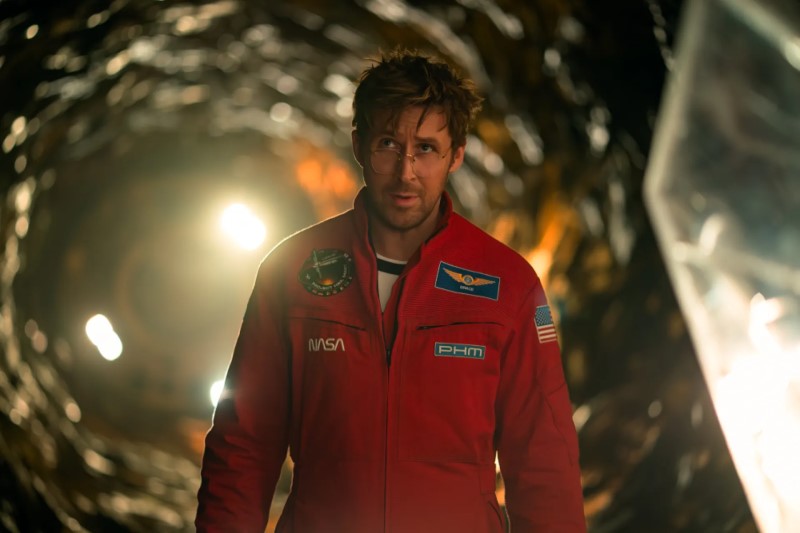
Project Hail Mary | Photo Credit Jonathan Olley
The $15 Amazon Fix
Throughout the film, audiences noticed a stunning, multi-colored rainbow flare hitting the highlights. Fraser revealed that this wasn’t some $5,000 piece of custom Hollywood glass. Rather, it was a cheap rainbow filter he found on Amazon. It worked perfectly, becoming a recurring visual theme for the movie.
INVISIBLE LIGHT AND CHICKEN WIRE
Directors Phil Lord and Christopher Miller, coming from an animation background, constantly threw out-of-the-box ideas at the camera department. To capture the otherworldly nature of deep space, Fraser pulled the Infrared (IR) filter out of one of the Alexa 65 cameras, allowing it to capture light spectrums invisible to the human eye.
The grip and electric team then built a literal chicken wire cage wrapped in tiny, blinking infrared Christmas lights around Gosling. To the naked eye on set, it looked like nothing. But through the modified Alexa 65, it rendered as a beautiful, blinking pink bokeh surrounding the astronaut. Add in a custom rig of water pouring through a funnel over two panes of glass in front of the lens, and the team created a “smeary, wet” visual texture entirely in-camera.
WORLD-BUILDING THROUGH COLOR: THE FOTOKEM SHIFT PROCESS
Cinematography does not stop at the camera sensor. To truly separate Grace’s terrestrial memories of Earth from the unknown, sprawling vastness of the Tau Ceti star system, Fraser partnered with renowned colorist David Cole. Together, they utilized Fotokem’s proprietary SHIFT process to execute a masterclass in world-building through color correction.
Instead of relying purely on digital LUTs (Look-Up Tables) to create the film’s analog patina, Cole and Fraser utilized a “dual film-out” process. This technique involves taking the pristine digital footage from the ARRI Alexa 65, printing it directly onto actual analog film stock, and then scanning that film back into the digital realm.
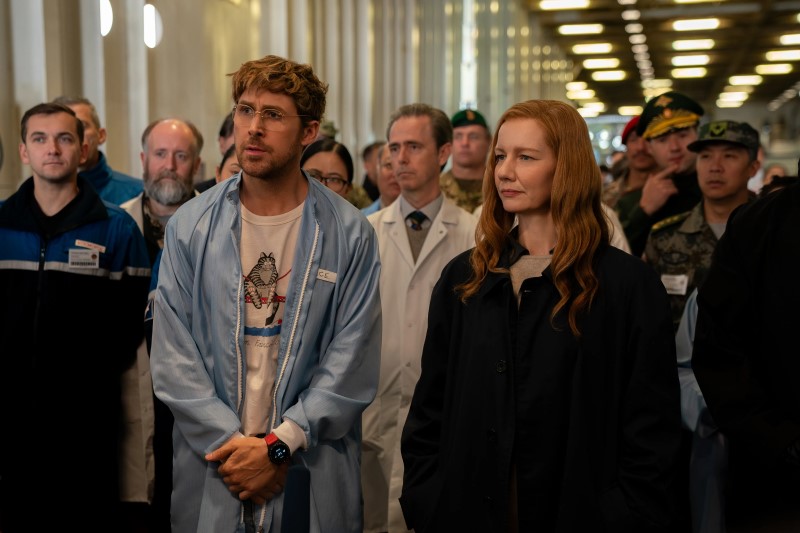
But they didn’t stop there. To subconsciously orient the audience, Cole utilized two completely different film stocks to grade the movie…
 |
 |
Earth Sequences
The flashback scenes set on Earth lean heavily into a gritty, textured, and slightly nostalgic film stock. This grounds Grace’s past in a tangible, familiar reality.
Space Sequences
For the deep space scenes aboard the Hail Mary, the team utilized a cleaner, large-format 70mm IMAX stock for the film-out process. This provided the space sequences with a massive, epic scope while still retaining that essential photochemical warmth and grain that digital sensors lack.

MASTER THE ART OF COLOR WITH DAVID COLEYou have seen how David Cole shaped the visual world of Project Hail Mary and Dune using advanced color science and deep look development. Now, it is your turn to learn his exact workflows. Whether you are matching cameras, building show LUTs, or mastering the emotional psychology of color, David breaks down his entire Hollywood process inside Filmmakers Academy. Explore David Cole’s Courses: |
GRADING THE INVISIBLE: THE PETROVA LINE
Cole’s color grading was also crucial in bringing the novel’s complex science to life visually—specifically, the Petrova line. Because the alien astrophage absorbs and emits infrared light, standard color science wouldn’t do the phenomenon justice.
By taking the infrared footage captured by Fraser’s modified Alexa 65 (which removed the camera’s internal IR filter), Cole was able to isolate and manipulate those specific invisible light spectrums in the grade. This collaboration between the camera department and the color suite resulted in the brilliant, glowing pink and magenta hues that define the Petrova radiation, giving the deadly phenomenon a dangerously beautiful, hyper-stylized look that pops massively on an IMAX screen.
ZERO GREEN SCREENS: GROUNDING A $250 MILLION BLOCKBUSTER
Perhaps the most shocking technical achievement of Project Hail Mary is what is missing from the set. According to Christopher Miller, the production used zero green or blue screens.
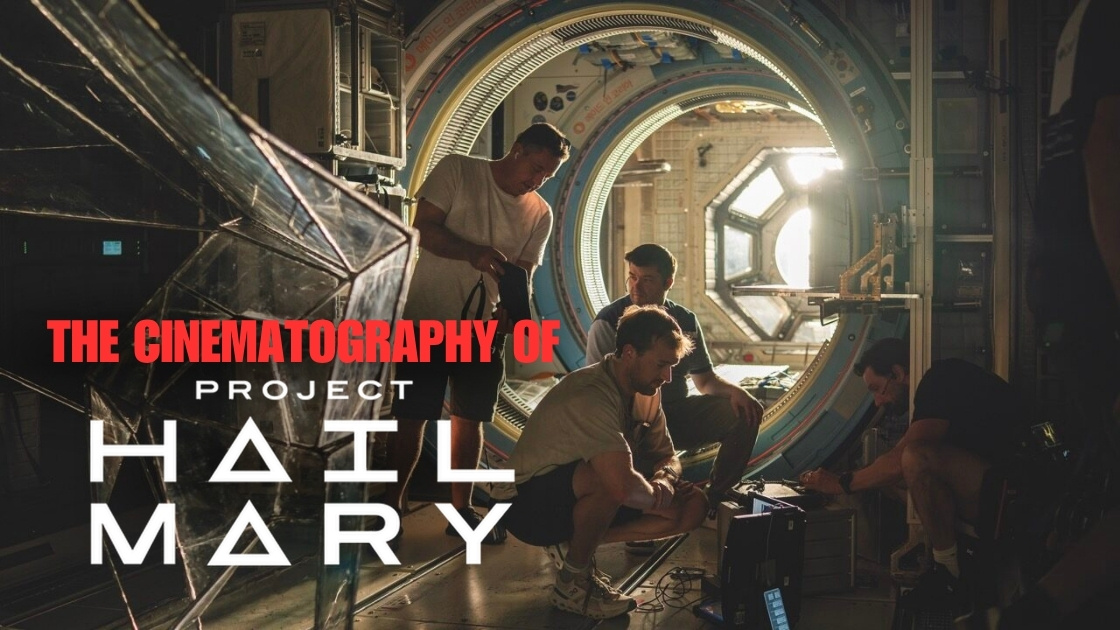
In an era where actors routinely perform opposite tennis balls in digital voids, the production built the entire spaceship as a practical set, inside and out. Ryan Gosling could actually touch the walls, push real buttons, and interact with physical stand-ins and animatronics for his alien co-star, Rocky.
Despite the massive budget, Fraser approached the sprawling physical sets with an indie-filmmaking mindset. Drawing on his early days shooting low-budget Australian films like Killing Them Softly and Animal Kingdom, Fraser asked himself, “Is this the simplest way to do something?”
Instead of filling the physical ship with massive, expensive Techno-cranes, Fraser frequently relied on a simple, low-profile tool called the “Hudson Slider”—invented by Australian DP Tim Hudson—to achieve dynamic, cost-effective camera movement in tight spaces.
THE ULTIMATE DP NIGHTMARE: LIGHTING THE XENONITE TUNNEL
Fraser has lit Batman and the deserts of Arrakis, but he called Project Hail Mary the “most challenging film I’ve ever done, by far.”
The crux of this challenge was the 70-foot tunnel where Grace first meets Rocky. According to the lore, the tunnel is made of “xenonite”—a translucent, solidified gas. The script required the harsh light of the sun to hit the entire 70-foot structure, passing through the material without making it look like cheap plastic.
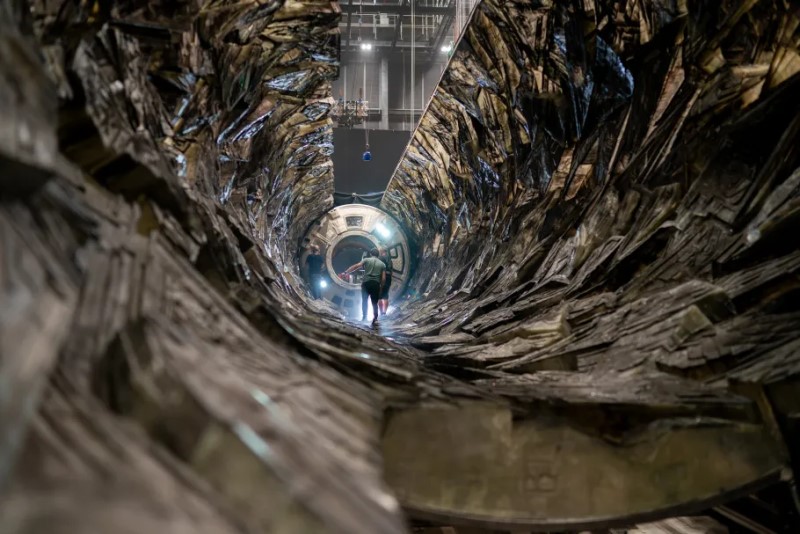
Tunnel in Project Hail Mary | Jonathan Olley
Fraser realized he physically could not source enough modern LED panels to generate the required output. Instead, his team had to build a massive, pixel-mapped lighting rig using hundreds of old-school, power-hungry tungsten lights. By pixel-mapping the tungsten rig, they could program the sun to rotate around the entire 70-foot tunnel in any configuration.
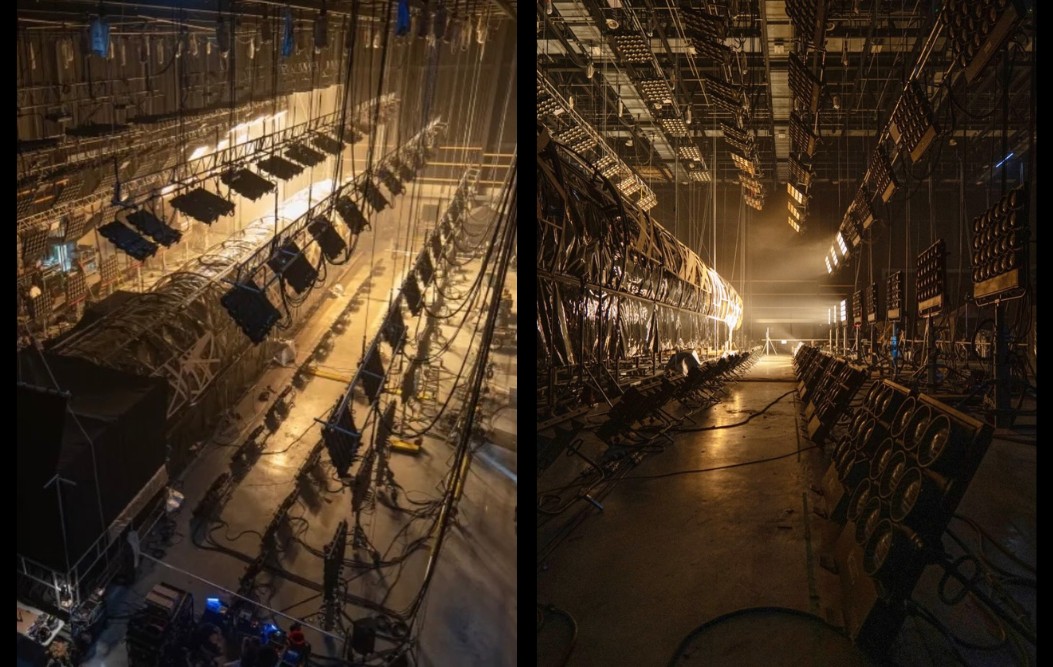
Behind the scenes of the tunnel | Photo Credit Tamás Papps
LIGHTING ROCKY: A “CHALLENGE ON A CHALLENGE”
If lighting a 70-foot translucent tunnel wasn’t hard enough, Fraser had to light the alien, Rocky.
Because Rocky’s side of the ship was completely dark, the alien could not emanate any light. He had to be entirely front-lit by the sun piercing the tunnel.
“If you talk to any DP, you’ll know that is what we have… we wake up in cold sweats,” Fraser joked. “Added to that, not only do we light this character with the front light, we light a character with a front light with no face, that looks like a rock, that looks like a spider.”
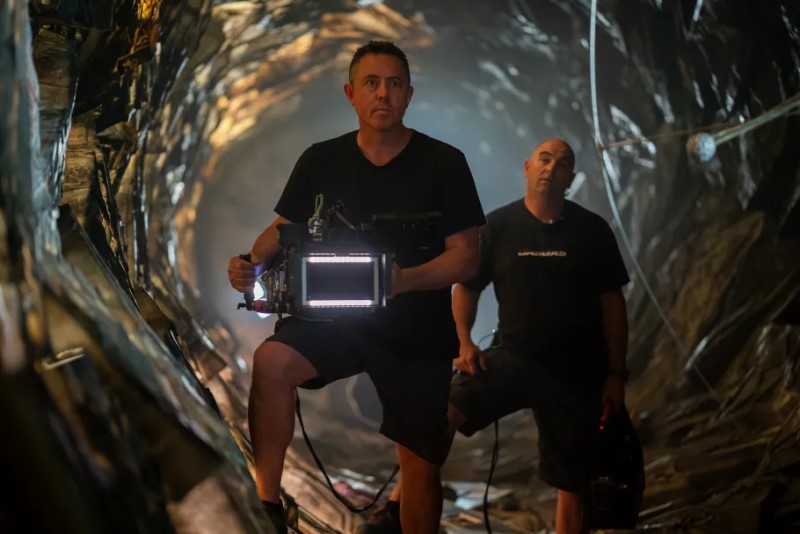
Cinematographer Greig Fraser | Jonathan Olley
Fraser was tasked with front-lighting a texture-heavy rock creature that could only emote through physical puppetry, completely devoid of human skin tones or facial features.
As Fraser put it: “It wasn’t just a challenge. It was a challenge on a challenge, on top of a challenge, under a challenge, through a challenge.”
THE BOTTOM LINE: A TACTILE TRIUMPH FOR SCIENCE FICTION
Project Hail Mary is a profound course correction for the science fiction genre. By completely abandoning the safety net of green screens and leaning heavily into practical ingenuity, Phil Lord, Christopher Miller, and Greig Fraser have proven that audiences desperately crave tactile reality, even in the deepest, most fictional corners of space.
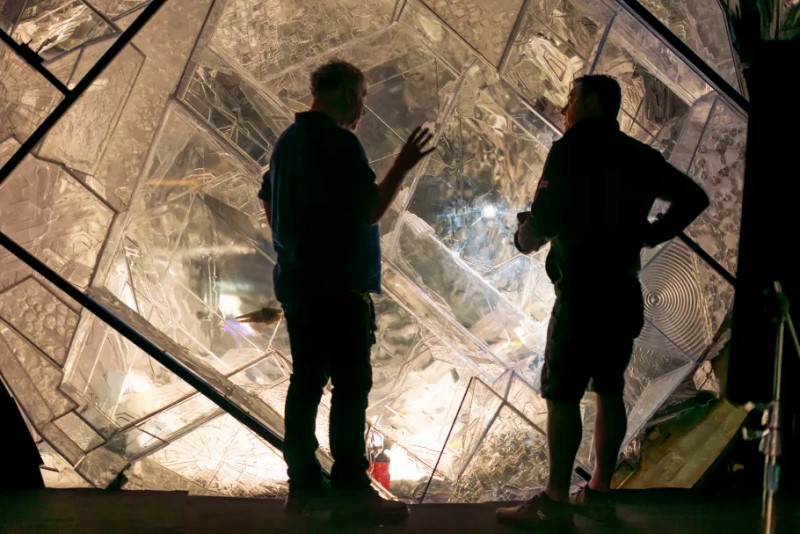
Filmmakers on set of Project Hail Mary | Jonathan Olley
From repurposing a $15 Amazon filter and vertically squeezing an IMAX sensor to building a multi-million-dollar, pixel-mapped tungsten rig, Fraser’s approach to the film underscores a critical lesson for modern filmmakers: technology should serve the story, not replace it. By prioritizing human connection and an imperfect, analog aesthetic over clinical digital perfection, the camera and color departments transformed a story about an isolated astronaut and a faceless rock alien into one of the warmest, most visually arresting epics of the decade.
As you approach your next project—whether it is a low-budget indie or a massive commercial endeavor—take a page out of Fraser’s playbook. Ask yourself the question he learned on the set of his early, low-budget films: “Is this the simplest way to do something?” Get your hands dirty, trust your practical elements, and never be afraid to break a few rules to find the humanity in your image.
JOIN FILMMAKERS ACADEMY AND SAVE $50!
Ready to take your filmmaking skills to the next level? Join the Filmmakers Academy community and gain access to exclusive content, expert mentorship, and a network of passionate filmmakers. Use code FABLOG50 to save $50 on your annual membership!
WORKS CITED
- Aldredge, Jourdan. “Breaking Down the Cameras and Aspect Ratios Used to Bring ‘Project Hail Mary’ to Life.” No Film School, 27 Mar. 2026.
- Growcoot, Matt. “‘Project Hail Mary’ Cinematographer Says Film Was ‘Challenging’, But Was Helped by Cheap Amazon Filter.” PetaPixel, 6 Apr. 2026.
- Hellerman, Jason. “How Did ‘Project Hail Mary’ Manage To Shoot a Space Movie with NO Green Screen?” No Film School, 4 Mar. 2026.
- L’Barrow, Nick. “Project Hail Mary cinematographer Greig Fraser talks filming Ryan Gosling sci-fi adventure.” Novastream Network, 13 Mar. 2026.
- Tangcay, Jazz. “‘Project Hail Mary’ Cinematographer Greig Fraser on How He Created the Sun Effect to Light the Tunnel Scene.” Variety, 2026.