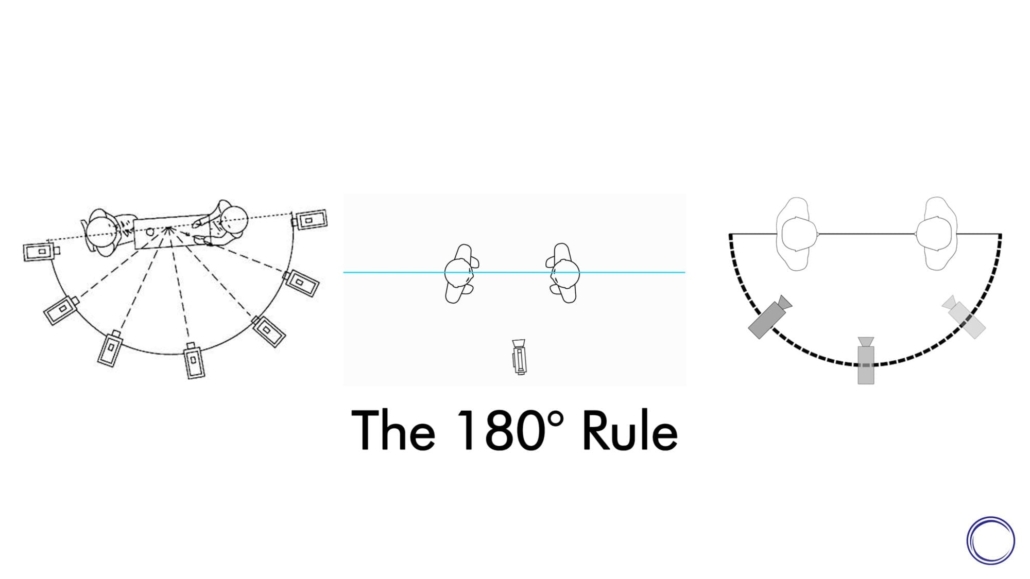
The 180-degree rule is one of the most important guidelines in continuity editing. Its primary purpose is to maintain consistent spatial relationships between characters and objects within a scene. This rule helps the audience understand the characters’ relative positions to one another. Following this rule ensures clear screen direction. It prevents viewer confusion and creates a smooth, immersive experience. It is a foundational element of conventional filmmaking.
The Axis of Action (The Line)
To use the 180-degree rule, filmmakers imagine an invisible line. This line is called the axis of action, or simply “the line.” It connects the two main subjects in a scene. These subjects are often two characters in a conversation. However, the axis can also connect a character and an object they are interacting with. To follow the rule, the filmmaker must place the camera on only one side of this imaginary line for the duration of the scene. This creates a 180-degree arc, or semicircle, where all camera setups are placed.
Maintaining Spatial Consistency
By keeping the camera on one side of the line, the rule preserves screen direction. Imagine two characters, Alex and Ben, having a conversation. The axis of action is the line running between them. If the camera stays on its side of the line, Alex will always be on the left side of the screen. Ben will always be on the right side. Their eyelines will also remain consistent. Alex will always appear to be looking from left to right. Ben will always appear to be looking from right to left. This spatial consistency makes the scene feel natural and easy to follow.
Crossing the Line (Breaking the Rule)
When the camera moves across the invisible axis to the other side, it is called crossing the line. This action breaks the 180-degree rule. The shot from the new side is called a reverse angle. Crossing the line has a jarring and disorienting effect on the audience. Suddenly, the characters’ screen positions are reversed. Alex will now be on the right side of the screen. Ben will now be on the left. Their eyelines will no longer match. They will appear to be looking in the same direction instead of at each other. This can confuse the viewer and break their immersion in the story.
Intentional and Unintentional Breaks
Most of the time, filmmakers avoid crossing the line. Filmmakers often consider an accidental break a technical error. However, a director might intentionally break the rule for a specific artistic purpose. A sudden jump across the line can create a feeling of chaos, conflict, or psychological distress. It can signify a major shift in power between characters. It can also be used to disorient the viewer during an intense action sequence. Like all cinematic rules, a filmmaker must first understand the 180-degree rule completely. Only then can they break it effectively and with clear narrative intent.