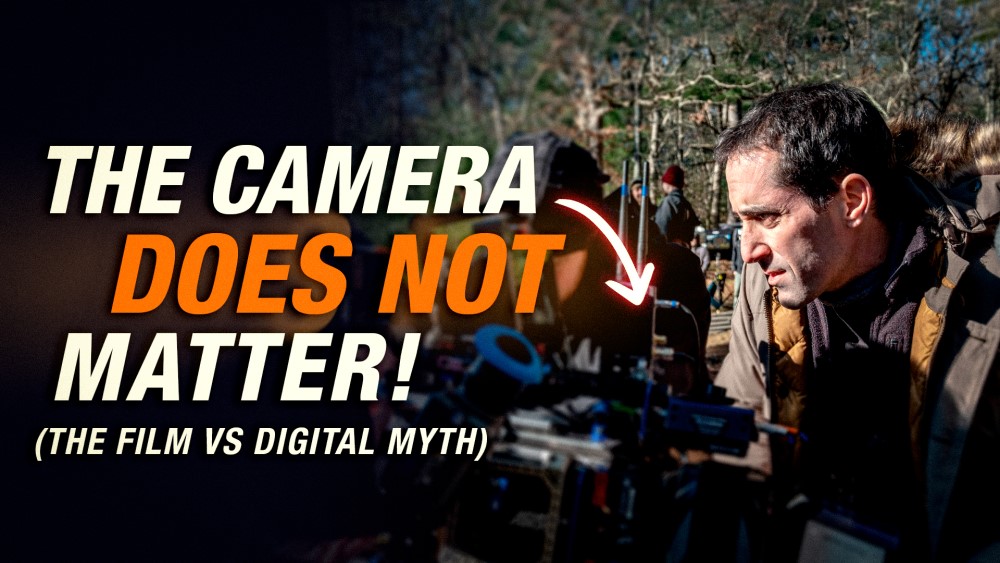
It is easy to get trapped in the endless debate of film versus digital. We obsess over camera bodies and sensors, arguing that one brand produces superior skin tones while another feels too clinical.
But according to cinematographer Steve Yedlin, attributing a specific look to a camera brand is nothing more than a superstition.
In a thought-provoking new breakdown, Yedlin discusses where a cinematographer’s real creative leverage actually lies: in processing image data, idiosyncratic problem-solving, and preserving your unique creative voice. He also broke down his 30-year collaborative history with director Rian Johnson—a partnership spanning nine feature films—and the practical techniques they used to shoot highly stylized memory sequences.
The Myth of the Camera Brand
Many filmmakers believe that shooting on film automatically guarantees a cinematic look. But as Yedlin points out, the word “just” does a lot of heavy lifting when people ask, “Why not just shoot on film?”
Yedlin explains that filmmakers often confuse being a user of a tool with being a developer. A camera original—whether it is a digital raw file or a piece of orange, flat film negative—is simply uninterpreted data. It is not the final look of your movie.
The magic does not happen in the camera body; it happens in the processing pipeline. The iconic look of film is the result of thousands of scientists and engineers developing chemical processes and contact printing over decades. Today, whether you shoot on an ARRI, a RED, or scan 35mm film, you still need someone to build a color pipeline to translate that uninterpreted data into a final photographic look. In fact, scanning film actually introduces an additional uninterpreted stage, which often requires more effort to prep for the intended look.
Stop obsessing over the capture device and start mastering what you do with the information after it is captured.

The Perspex Flashback: A Practical Case Study
This deep understanding of how images are processed allows Yedlin to make bold, practical choices on set. When tasked with shooting flashbacks that required an unreliable, memory-like quality, Yedlin and Johnson did not default to heavy post-production filters.
Instead, they used ordinary, colored perspex (plexiglass)—primarily in red and blue—placed in front of the lens. This practical trick obscured parts of the frame, creating the visual impression of looking through a stained glass window. It gave the narrator’s memory a distinctly subjective, unrealistic quality.
But practical filmmaking always introduces logistical hurdles. For wider, moving shots where mounting a piece of perspex in front of the lens was impossible, Yedlin had to adapt. His solution was to mimic the perspex colors environmentally. He lit the exterior of the windows with a totally unrealistic, primary blue or heavy red light. By echoing the rhyming colors of the perspex through the windows, the flashback sequences maintained their visual continuity without restricting the camera’s movement.
Do Not Become an Interchangeable Cog
The film industry can be incredibly frustrating when you are trying to break in. Yedlin and Johnson met when Yedlin was a high school senior and Johnson was a college freshman, volunteering on student film sets. They practiced their craft by shooting informal, disposable weekend films. That shared curiosity built a working relationship that continues to this day.
It is tempting for emerging filmmakers to try and mold themselves into exactly what they think producers want. But Yedlin leaves us with a critical piece of advice: do not sell out when nobody is asking you to.
If you try to conform to every industry expectation, you make yourself completely interchangeable. To build a lasting, creative career, you need to stay true to the specific, sometimes weird, idiosyncratic things that make you passionate about cinema. That unique perspective is your actual selling point.
JOIN FILMMAKERS ACADEMY AND SAVE $50!
Ready to take your filmmaking skills to the next level? Join the Filmmakers Academy community and gain access to exclusive content, expert mentorship, and a network of passionate filmmakers. Use code FABLOG50 to save $50 on your Annual membership!