Sound represents 50% of the cinematic experience, yet traditional film productions almost universally relegate it to post-production. A composer receives a locked edit months after wrap, foley artists recreate shoe scuffs on a soundstage, and sound designers replace production audio with synthetic library assets.
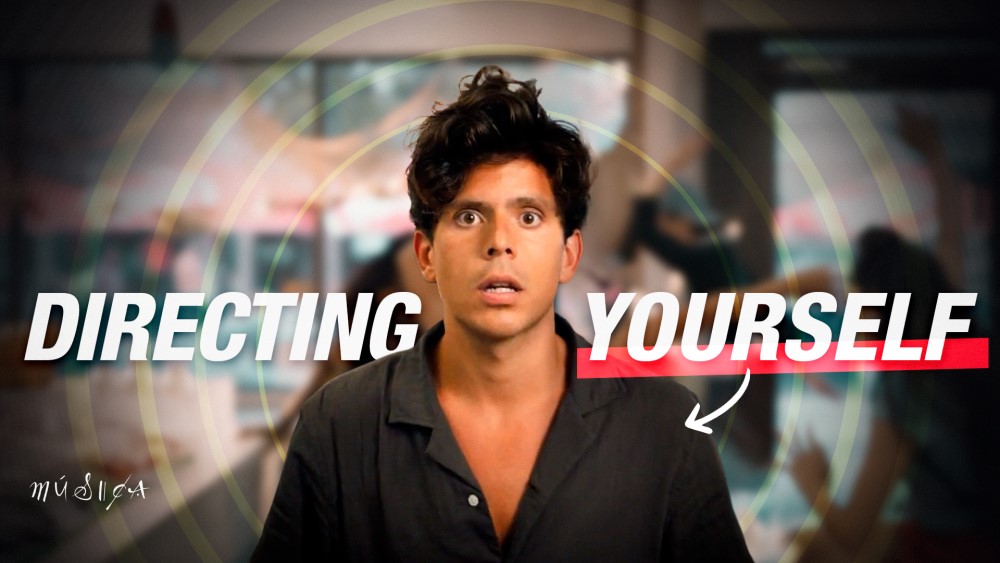
When Rudy Mancuso set out to direct and star in his feature film Música, he inverted that traditional hierarchy entirely.
Rather than treating sound as an afterthought, Mancuso transformed everyday environmental noise—scraping chairs, sizzling pans, ticking turn signals, and chopping knives—into the foundational rhythm driving the entire narrative.
One Big Umbrella: Directing as Composing
On most feature sets, creative responsibilities are strictly compartmentalized. Directors block scenes, cinematographers shape lighting, actors execute dialogue, and the sound department monitors boom levels for clarity.
For Mancuso, those boundaries had to be eliminated:
“Directing was composing, composing was writing, and writing was acting. They’re all so heavily intertwined… It wasn’t like we defer to a music department to handle all the music. The music is quite literally happening in the middle of the dialogue, in the middle of the scene.”
— Rudy Mancuso
Handling every role simultaneously meant that scoring happened in real time on the shooting floor. The narrative was conceived through an auditory lens, forcing the crew to abandon standard production assumptions and build a workflow where the audio dictated camera motion, actor blocking, and scene transitions.
Inventing the “Rhythm Performer”
To turn physical reality into music, the production had to create an entirely new crew classification: the Rhythm Performer.
These were not background extras pretending to work, nor were they traditional dancers hitting marks to a playback track. Mancuso cast veteran STOMP performers and street drum corps artists who possessed the physical dexterity to turn ordinary objects into percussion instruments.
Equipped with brooms, forks, knives, and kitchenware, these performers interacted with the physical space to build intricate polyrhythms live during takes. Their movement established the timing of the scene, creating a kinetic pulse that motivated camera pans, zooms, and character pacing.
Tuning the Physical Environment
Capturing everyday objects as musical instruments requires surgical art department and prop coordination. You cannot simply hit a random frying pan and expect it to blend harmoniously with a melodic chord progression.
Prior to shooting, the team visited commercial kitchen supply stores to hand-select pots and pans that rang out at exact musical pitches, such as a tuned B-flat. When building specific set pieces—like a commercial fish-chopping station—the construction department modified the prep tables with internal acoustic cavities. Striking the side of the table or chopping down on the board produced distinct, resonant bass tones and percussive clacks tailored directly to the film’s score.
The filmmakers engineered every surface the camera moved past to function as an acoustic instrument.
Why Live Sound Beats Foley: Deploying 99 Microphones
The standard Hollywood argument against recording complex practical sound live is efficiency. Capturing rhythm live on set costs precious production hours that could easily be outsourced to foley artists and mixers in post-production.
Mancuso’s rebuttal was simple: you cannot synthesize the energy of the room.
Foley recorded in an isolated booth lacks the natural room acoustic, the subtle timing variations, the spatial swing, and the collective energy of a living set. To capture this visceral dynamic, the sound department executed what cinematographer Shane Hurlbut, ASC referred to as “pre-mics instead of pre-lights.”
On peak rhythm setups, the production deployed up to 99 microphones simultaneously:
-
Contact mics adhered beneath countertops and prep stations
-
Boundary mics planted along floorboards and walls
-
Individual wireless lavs mounted to performers and practical props
-
Multi-layered room and overhead boom arrays capturing natural reverb
Every take yielded a distinct acoustic performance. Because the music was recorded live, the actors reacted to genuine auditory cues rather than imaginary post-production sound effects, completely transforming the authenticity of their performances.
The Three-Minute Rule: Sound in the Streaming Age
Designing sound for cinema requires adapting to modern viewing environments. While theatrical releases grant filmmakers a captive audience that has invested time and ticket money to sit in the dark, streaming platforms offer no such patience.
On modern digital platforms, filmmakers have roughly two to three minutes to hook a viewer before they abandon the film for another title. Using dynamic, hyper-detailed practical sound design from the very first frame immediately establishes a distinct visual and auditory world. When sound operates as an active storyteller rather than passive background ambience, it commands viewer attention and bridges the gap between the screen and the audience.
On-Set Audio Integration Checklist
-
Pre-Tune Practical Props: Audit hand props (cutlery, glassware, cookware, tools) with an acoustic tuner during prep. This ensures impacts align with the tonal key of the scene.
-
Modify Set Construction for Resonance: Work with the art department to hollow out counters, reinforce hollow boxes, or install sound-dampening beneath surfaces. This depends on whether an object needs to ring or produce a dead thud.
-
Conduct Pre-Mic Walkthroughs: Schedule dedicated sound checks with the sound mixer prior to blocking. Identify placement points for plant mics, contact transducers, and boundary capsules.
-
Coordinate Lighting and Mic Placement: Ensure the DP and gaffer establish lighting angles that allow boom operators. And plant mics to capture practical audio without casting unwanted boom shadows across action zones.
-
Record Extended Room Tone and Wild Foley: Capture isolated takes of practical rhythms and physical impacts immediately after scene wrap. All while the ambient acoustics of the location remain identical.
JOIN FILMMAKERS ACADEMY AND SAVE $50!
Ready to take your filmmaking skills to the next level? Join the Filmmakers Academy community and gain access to exclusive content, expert mentorship, and a network of passionate filmmakers. Use code FABLOG50 to save $50 on your Annual membership!